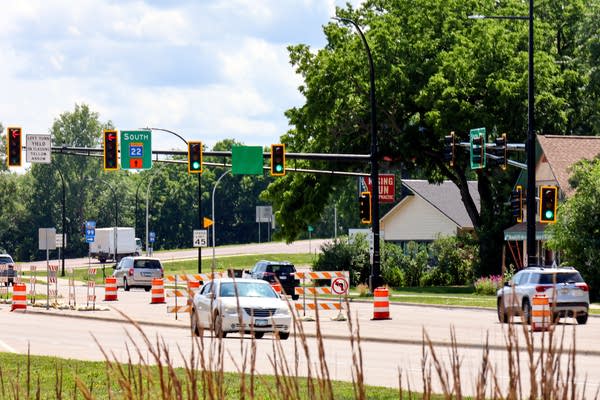
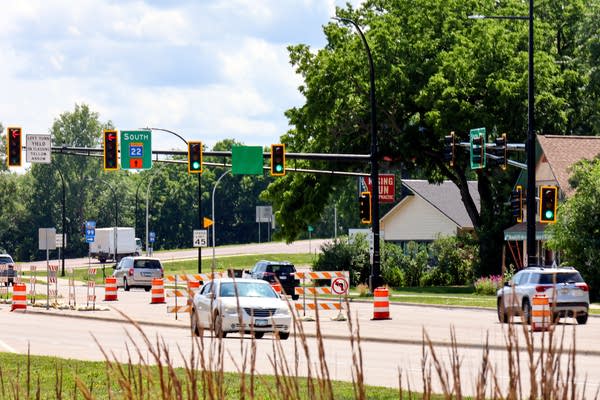
Getting through the city of St. Peter this summer requires a little extra time and a lot of patience.
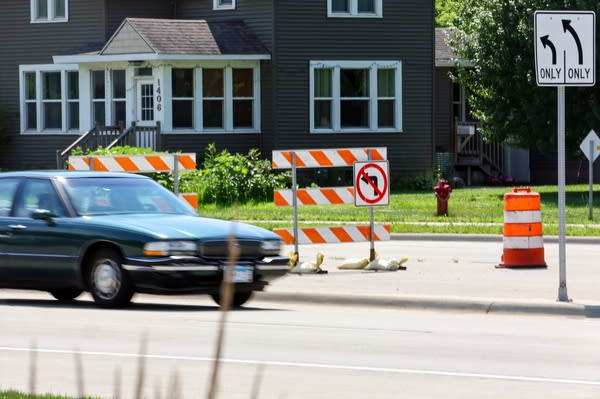
Drivers are greeted with the familiar sight of bright orange barrels, barricades and signs pointing to detours during the ongoing State Highway 22 construction project from Mankato to St. Peter.
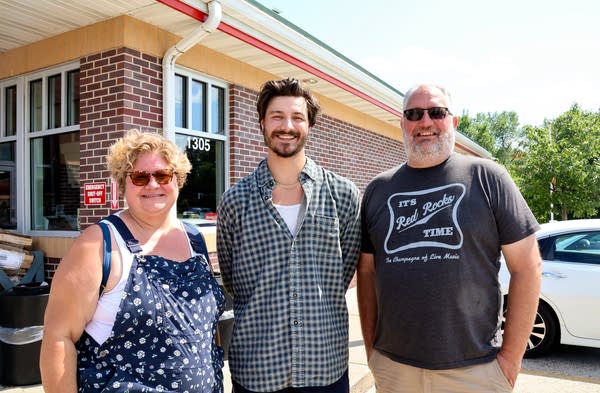
While some motorists might find the detours frustrating and inconvenient as they work their way around the town to get to their final destination, others weren’t really bothered by it. Calvin Boman, 25, of Cedar Rapids, Iowa, was navigating his way through the detours with his parents as they headed up to visit his sister in St. Paul for the Fourth of July weekend.
“I always tell myself when I see construction on the road that it’s giving people jobs and also making sure it’s better the next time I’m going over it,” Boman said. “So I never mind [seeing] a lot of construction.”
Calvin’s father, Mike Boman, 54, also of Cedar Rapids, Iowa, said whenever they go through Minnesota, they don’t usually have an issue with poor road conditions or construction.
“Iowa doesn’t do too bad of a job either, so I don’t really notice,” Mike said. “There’s some other states that sometimes we kind of question. We go down to Missouri some, and that can be a little rougher.”
The roads in Minnesota are considered to be in pretty rough shape, too, according to this year’s Infrastructure Report Card by the American Society of Civil Engineers. The group gives the state’s roads a dismal D+ grade. But by another measure, the state’s roads aren’t too bad and appear to be getting better.
Nearly 1 in 11 miles of U.S. roads are considered to be in poor condition, according to a report by the online financial marketplace LendingTree, which cited data from the Federal Highway Administration. But Minnesota’s roadways are much better than the national average, with just 3.6 percent of the state’s roads rated in poor condition.
And the report noted that Minnesota led the entire country in reducing the share of its roads in poor condition. The percentage of roads in poor condition was 9.2 percent in 2019, but that plummeted to just 3.6 percent in 2024, an improvement of nearly 61 percent.
And there seem to be some signs of improvement, partly because of state and federal investments like Minnesota’s bonding bill, which lawmakers passed in 2023, and former president Joe Biden’s federal Infrastructure Investment and Jobs Act, which provided funding to expand, repair and improve infrastructure statewide.
State lawmakers passed another $1.2 billion bonding and infrastructure package this year, which was signed into law by Gov. Tim Walz last month. The legislature designated about $176 million statewide for transportation improvements, including $47 million allocated for local road improvements.
There are over 200 statewide projects announced in 2026 focused on improving transportation infrastructure, according to the Minnesota Department of Transportation (MnDOT).
“We have a robust 2026 road construction season ahead of us,” said MnDOT Commissioner Nancy Daubenberger in a news release. “When complete, these projects will help people get around more easily, improve safety, create smoother pavement and improve connectivity for everyone who relies on our multimodal transportation system.”
But without consistent funding over the next several years, experts warn these improvements might only be temporary.
According to the ASCE report, the state’s infrastructure is rapidly aging, and the inflationary cost of repairing and improving roads and bridges is increasing sharply. Before the most recent bonding bill passed, the civil engineering group projected Minnesota will have a road construction funding shortfall of $20 billion over the next 20 years.
Forrest Hasty is the assistant district engineer for MnDOT District 7, which includes 13 counties in southwest Minnesota and is a mostly rural region. He said in recent years, the amount of funding the district received has dropped a bit as funds are split among all districts across Minnesota for projects, with his district receiving about 6.5 to 7 percent from the pot.
About 40 percent of District 7’s budget goes to pavement, 17 percent to bridges and 9 percent to roadside infrastructure, Hasty said. Recent projects include a $5 million grant for three roundabouts and a $37 million project on Highway 169 between Mankato and St. Peter.
The district’s 2026 budget is about $60 million. Hasty said it is important to collaborate with counties and cities while minding the impact of funding fluctuations and inflation on project costs as they work to improve the region’s roads and infrastructure.
“That’s the job. Reduce the poor roads — that’s what we do every day,” Hasty said. “And we try to use the dollars that were provided to do as many roads as we can and make them as safe and as smooth for the taxpayers of Minnesota.”
‘Our taxes are paying off’
Back in St. Peter, William Slater, 74, of Worthington, was working his way through the construction zone on his way to visit his eight grandchildren in the Twin Cities. He said he doesn’t mind if his trip takes more time because of the amount of construction work happening on the roads.

“Our taxes are paying off,” Slater said. “You got to fix the road up sometime. We can only do construction late spring, summer, early fall, so you got to sacrifice a little bit if you want good roads. We got good roads going to the cities, so we can’t complain.”