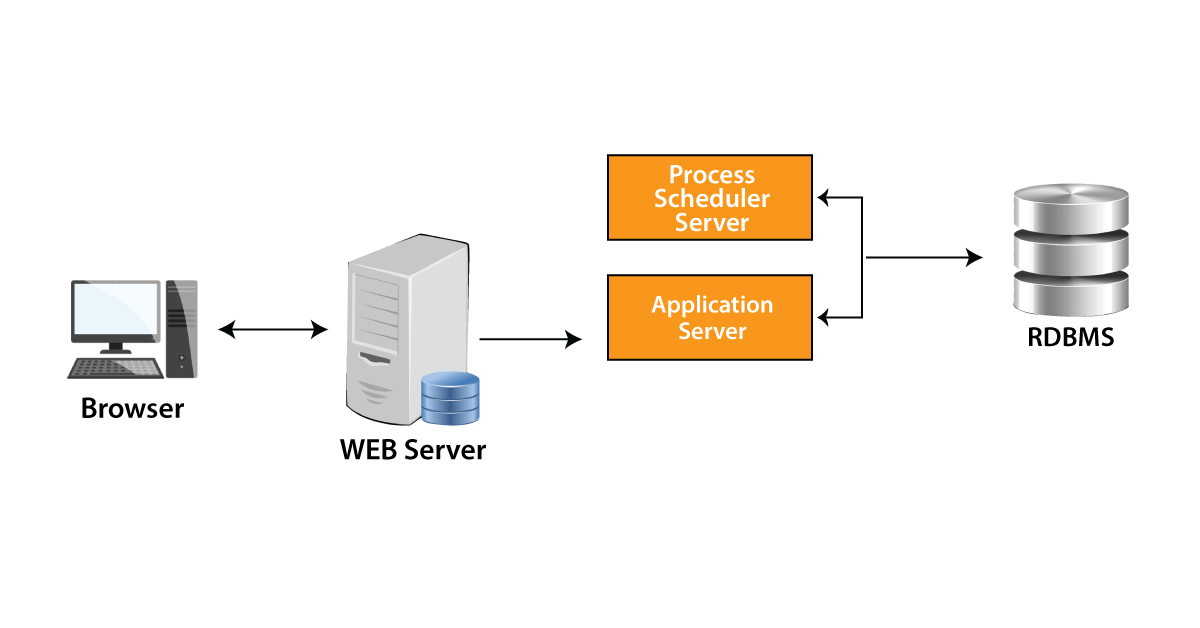
PeopleSoft Architecture | Understanding PeopleSoft Architecture


PeopleSoft Architecture – Table of Content

In this blog, We are going to learn about the architecture of Peoplesoft in detail. So without wasting our time, let’s get on with it.

PeopleSoft application operates under PeopleSoft Internet Architecture that needs various Hardware and Software components such as 

  • Database server
  • Process Scheduler server
  • Application server
  • Web browsers
  • Web Servers

We need to understand the role of every component before deciding the configuration options that are most appropriate for the implementation.

implementationThe requests are sent by the web browser to the web server. The web server will pass the request to the application server, which will generate the SQL to be executed in the database.

The configuration of the PeopleSoft infrastructure is not only about enabling the deployment of Internet applications via a browser. PeopleSoft allows us to benefit from many of PeopleSoft’s Internet, intranet, and back-end solutions, that includes service-orientated architecture, Performance Monitor, Feeds Framework, PeopleSoft Interaction Hub, and Search Framework.

           We have the perfect professional PeopleSoft Admin Training course for you. Enroll now!

PeopleSoft Admin Training

  • Master Your Craft
  • Lifetime LMS & Faculty Access
  • 24/7 online expert support
  • Real-world & Project Based Learning

Database Server: 

The database server hosts a database engine and PeopleSoft application database consisting of all PeopleTools application definitions, metadata, system tables, application data, and application tables. The database server manages the connections of the application server, the connections of the development environment, and the batch programs executing against it at the same time. The PeopleSoft database is the repository of all the information that the PeopleSoft application manages. PeopleSoft application data and metadata are stored and kept up to date within the database. Application Designer is the primary tool in the development environment, allowing us to define, edit and manage this metadata that the system uses to control the execution architecture. This metadata collection specifies a PeopleSoft application.

Process Scheduler server: 

PeopleSoft Process Scheduler environment is also called the “batch” environment. This is where most of the batch programs like Application Engine programs run, and that’s where you installed the COBOL and SQR executables. In a multi-server environment, we can choose where to find your Process Scheduler environment depending on server availability and performance requirements. Within the topology of PeopleSoft, Process Scheduler can be installed on a separate server, or it may be executed on the database server or application server.

                                 We have the perfect professional PeopleSoft HRMS Tutorial for you. Enroll now!

Application servers and associated components:

Application server: It is the heart of PeopleSoft’s Internet architecture. The business logic is executed by the application server and SQL is submitted to the database server. The application server is made up of many PeopleSoft server processes that are grouped into domains. Every server process in a domain offers unique processing capabilities, allowing the application server to effectively respond to multiple transactional requests produced in the PeopleSoft architecture. Application servers need locally installed database connectivity software to keep SQL connected to RDBMS. You need to install the necessary connectivity software and related utilities for your RDBMS on any server where you plan to run the PeopleSoft application server.

Once an application server has established a database connection, any device which issues a transaction request across the application server benefits from the direct connection of the application server to the database.

  • Oracle Jolt and Tuxedo: PeopleSoft utilizes Oracle Tuxedo for managing transactions between the application server and the database. PeopleSoft uses Oracle Jolt to make it easier to communicate between PeopleSoft running on the webserver and Tuxedo running on the application server. Oracle Tuxedo and Jolt are mandatory components of PeopleSoft’s application server.
  • Domains: A domain is a set of supporting processes, server processes, and resource managers which allows the database connections necessary to meet application requests. Every domain is managed with a separate configuration file, and every application server domain is configured for connecting to a single database. One application server machine may support more than one application server domain executing on it. Using the psadmin utility, we can configure the application server domain.

HKR Trainings Logo

Subscribe to our YouTube channel to get new updates..!

  • Peoplesoft server Processes: When we start an application server domain, it will start all the server processes related to this domain. Many server processes are executed in a domain. Every server process creates a permanent connection to a PeopleSoft database, which acts like a generic SQL pipeline which is used by server processes for sending and receiving SQL. Every server process utilizes its own unique SQL connection to make requests from several sources easier. From an RDBMS point of view, every server process in a domain represents a logged-on user.
  • Services: When a request is submitted to the application server by a PeopleSoft application, service name and a set of parameters are also submitted like MgrGetObject and also its parameters. The transaction request is queued by the Tuxedo to a particular server process which is designed to manage certain services. When the server process starts, it informs the system about the predefined services it manages.
  • Listeners, Handlers, and Queues: All these Listeners, Handlers, and Queues form the basis for the functionality of a domain. They receive requests, direct the requests, store the requests, follow-up requests, and respond to return requests.

Web Servers:

A Java-compatible web server is needed for extending the architecture of PeopleSoft to the Internet and intranet. When Peoplesoft Internet Architecture is installed on the webserver, a collection of Java servlets was designed to handle a wide variety of PeopleSoft transactions from the Internet or Intranet.

PeopleTools supports and offers the following standard web servers to be used in the PeopleSoft implementation:

  • IBM WebSphere
  • Oracle WebLogic
  • PeopleSoft Servlets

The following are the PeopleSoft servlets available on the webserver:

  • PSIGW:
  • Portal
  • PSEMHUB
  • PSINTERLINKS
  • Report Repository

Web browsers:

Peoplesoft Applications and administrative tools can be accessed by the supported Web browser. It is unnecessary to install any other software on the workstation that runs the browser, like the connectivity software or the downloaded applets.

PeopleSoft only sends the following elements to the browser:

As the browser only handles this core Internet content, the client workstation is not overloaded by an unnecessary processing responsibility. The entire process is performed at the server level.

    Click here to get frequently asked PeopleSoft Admin interview questions for freshers & experienced professionals

PeopleSoft Admin Training

Weekday / Weekend Batches

Conclusion: 

In this blog, we have gone through the architecture of Peoplesoft and the components of Peoplesoft architecture. I hope you found this information useful.

Related Article:

Peoplesoft Data Management Training


Source link

Leave a Reply

Subscribe to Our Newsletter

Get our latest articles delivered straight to your inbox. No spam, we promise.

Recent Reviews


Azure Traffic Manager – Table of Content

What is Azure Traffic Manager?

Azure Traffic Manager distributes traffic to services across the Azure regions. It is a DNS-based traffic load balancer that provides responsiveness and high availability of the services. The Traffic Manager considers the health of all the endpoints and uses DNS to route client requests to a service endpoint based on a traffic-routing method.

A service endpoint might be an application hosted on Azure or an internet-facing application outside of Azure. To suit the needs of different applications, the Azure Traffic Manager offers several endpoint monitoring options and traffic routing methods. It balances the traffic load on services according to set policies. 

Features of Traffic Manager

Here are the features that the Traffic Manager offers.

  • The Traffic Manager continuously monitors endpoints. If, in any case, an endpoint goes down, then it provides automatic failover, which results in increased application availability.
  • The services hosted on Azure run in data centres located around the world. The traffic manager routes traffic to the endpoint with the lowest latency. This improves application responsiveness.
  • If you plan for service maintenance of your applications, then the traffic at the time of service maintenance will be routed to the next best locations, which are alternative endpoints. So, users can perform operations without downtime.
  • The Traffic Manager also supports non-Azure endpoints, which might be on-premise or on hybrid cloud scenarios. These scenarios include burst-to-cloud, migrate-to-cloud, and failover-to-cloud scenarios.
  • It provides various traffic routing methods. We can combine the routing methods to create a nested Traffic Manager profile for more complex deployments.
  • Based on user traffic volumes and patterns, it provides actionable insights. You can get a view of where the users are interacting with the application and the quality of their digital experience.
  • It adheres to the applications of data sovereignty regulations by using geographic fencing.

How does Traffic Manager work?

The key benefits of the Traffic Manager are,

  • The traffic distribution is based on one of the traffic-routing methods provided by Azure.
  • It continuously monitors the health of the endpoints and implements automatic failover.

A client connects to a service using a DNS name. The Traffic Manager will first resolve the DNS name of the service to the IP address. The client is then connected to the IP address of the service to access it. The Traffic Manager works at the DNS level, where it routes traffic to a specific endpoint based on a selected traffic routing method. It is neither a proxy nor a gateway. Clients will directly connect to the selected endpoint. The Traffic Manager will not see the data passing between the client and the service.

Become a Microsoft Azure Certified professional by learning Microsoft Azure certification course from hkrtrainings! 

How does a client connect to the Traffic Manager?

When a client wants to connect to a service, a DNS query will be sent to the configured recursive DNS service. A recursive DNS service, which is also known as local DNS, does not host the domains directly. It rather encompasses the process of contacting authoritative DNS services to resolve the DNS name. The recursive DNS finds the name server across the internet for the domain in the DNS query sent by the client.

It then contacts the name server to request the DNS record. It then returns the record that points to the traffic manager of the server. The DNS then sends a request for the traffic manager. Upon receiving the request, the traffic manager chooses an endpoint. The chosen endpoint is sent back as a DNS name record. The recursive DNS service finds the domain name server. The IP address of the service endpoint will be returned. The recursive DSN consolidates and gives a single DNS response. The client then connects to the IP address. 

Microsoft Azure Certification Training

  • Master Your Craft
  • Lifetime LMS & Faculty Access
  • 24/7 online expert support
  • Real-world & Project Based Learning

Routing methods in Traffic Manager

To route traffic to different endpoints, Azure Traffic Manager supports six types of traffic-routing methods. The routing method specifies which endpoint is returned through DNS.

  • Priority – When you want to send primary service endpoints for all traffic, you can use the priority method. It provides backup if the primary endpoint is unavailable.
  • Weighted – When you want to distribute traffic across endpoints based on some pre-defined weights or evenly, use the weighted method.
  • Performance – When you want the users to interact with the lowest latency endpoint, then you can use the performance method. In this scenario, the endpoints are located in different geographic locations.
  • Geographic – When you want to route users to a specific endpoint based on the geographic location of the user, use the geographic methods. It employs data sovereignty based on different regions.
  • Multivalue – You can use multivalue when you only have IPv4/IPv6 addresses as endpoints. When a query is received, all the healthy endpoints are returned.
  • Subnet – If you want to map a set of user IP addresses to a specific endpoint, use the subnet method. When a request is received, the endpoint mapped to the source IP address will be returned.

Endpoints in Traffic Manager

An endpoint is referred to as application deployment. When the Traffic Manager receives a DNS request, it checks for all the endpoints and chooses an available one, and returns it as a DNS response. Traffic Manager supports the below 3 types of endpoints.

  • Azure endpoints – These are the services hosted in the Azure cloud.
  • External endpoints – These are the services hosted outside of the Azure cloud like on-premise or a different hosting cloud. These are used for IPv4/IPv6 addresses.
  • Nested endpoints – When you want to create more flexible routing schemes, you can use nested endpoints to combine Traffic Manager profiles for complex deployments. A single Traffic Manager profile can have any type of endpoints in it.
HKR Trainings Logo

Subscribe to our YouTube channel to get new updates..!

Creating a Traffic Manager for an application

Let us create a Traffic Manager profile that provides high availability for your application. Navigate to https://portal.azure.com/ and log in to your Azure account. You have to deploy your web application in two different Azure regions. So, one will act as a primary endpoint and the other acts as a failover endpoint.

Learn more about AWS vs Azure from this Article Difference between Azure and AWS!

Deploy the web application

Click on the ‘Create a resource’ button on the top-left corner. Click on ‘Web’ and click on ‘Web App’. You will get a Basics tab where you can fill in the web application details. Create a resource group and give a name for it. Give a name for your web application. Select ‘Code’ for the ‘Publish’ field. Give ‘ASP.NET V4.7’ for ‘Runtime stack’, select Windows for ‘Operating System’, select ‘East US’ for the ‘Region’ field. Create a new service plan and give a name for it. Select ‘Standard S1’ for the ‘SKU and size’ field.

Go to the Monitoring tab, select no for the ‘Enable application insight’s option. Click on ‘Review and create’. You will get a review page where you can view all the settings. Click on ‘Create’ to create a website. Follow the same steps to deploy the web application in a different Azure region.

Creating a Traffic Manager profile

Click on ‘Create a resource on the top-left corner. Click on ‘Networking’ and then click on the ‘Traffic Manager profile’. Click on ‘Create Traffic Manager profile’ and a settings page appear. Give a name for the Traffic Manager profile, Select ‘Priority’ for the ‘Routing method’ field, select a subscription method, select your existing resource group, and give the location of the resource group for the ‘Location’ field. Click on ‘Create’ to complete the process.

Add endpoints to Traffic Manager

Give the Traffic Manager profile name in the search bar and select your profile from the results. Click on ‘Settings’ in the Traffic Manager profile. Click on ‘Endpoints’ and then click on ‘Add’. Select ‘Azure endpoint’ for the ‘Type’ field. For the ‘Name’ field, enter the endpoint that you want to set as the primary one. Select ‘App Service’ for ‘Target resource type’, select ‘Choose an app service > East US’ for ‘Target resource’, choose 1 for ‘Priority’ field, and click on ‘OK’. Repeat the same steps for the other endpoint and set the priority as 2.

Testing the Traffic Manager profile

You can find the DNS name of your web application in the overview of your Traffic Manager profile. Enter the DNS name in a browser, and you will get the default website of your web application. Now, disable your primary site in the Traffic Manager profile. Select your primary endpoint in the overview section. Click on ‘Disabled’, and then click on ‘Save’. You can observe the status as disabled when you close the primary endpoint. Check the same DNS name in a different browser, you can see that your web application is still available. You are routed to the failover endpoint.

Microsoft Azure Certification Training

Weekday / Weekend Batches

Conclusion

Now that you know how to create a Traffic Manager profile, deploy your web application, create multiple endpoints, and try setting up a Traffic Manager profile. It widely improves website response. To reference an Azure Traffic Manager profile, you can also create an alias record name. You can create a Traffic Manager profile through the Azure portal, Azure CLI, and Azure PowerShell. It follows a pay per use pricing plan.

Other related articles:


Source link