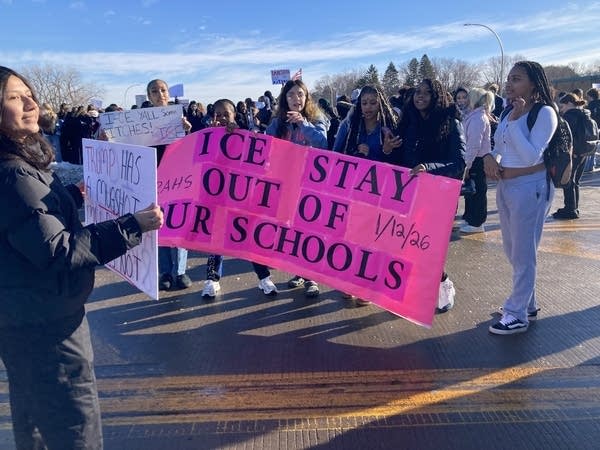
When federal Immigration and Customs Enforcement agents arrived in Minnesota, Century Elementary School principal Mike LeMier said fear spread through his community in Park Rapids, Minn., three-and-a-half hours north of the Twin Cities.
But the students who seemed the most worried weren’t immigrants.
“Many Native American students directly asked me whether they were safe,” LeMier told state lawmakers during a hearing in April. “The fear was real.”
LeMier said students in his district started missing class because families were afraid to leave their homes. Other families missed school and work to travel long distances to obtain tribal identification cards.
The impact of Operation Metro Surge on his community in Greater Minnesota was “unexpected” and “significant,” he said.
That was the case for the vast majority of Minnesota school principals, according to a recently released survey from the University of Minnesota.
Hundreds of school leaders — at least one in five — responded to the survey, which was conducted in mid-March. More than 80 percent said the surge negatively impacted their students’ ability to learn.
About 75 percent said the surge led to thousands of students missing school with some 1,400 dropping out or unenrolling.
“These counts are likely underestimates,” Sara Kemper, a researcher at the University of Minnesota’s Center for Applied Research and Educational Improvement, told Minnesota senators recently, adding that not all survey respondents included numbers with their answers.
It wasn’t just about missing school. Principals said that dozens of students were detained by U.S. Immigration and Customs Enforcement agents; 849 had a parent or guardian detained.
In the White Bear Lake School district, Birch Lake Elementary principal Julian Stanke said bus stops were especially frightening for students and their families.
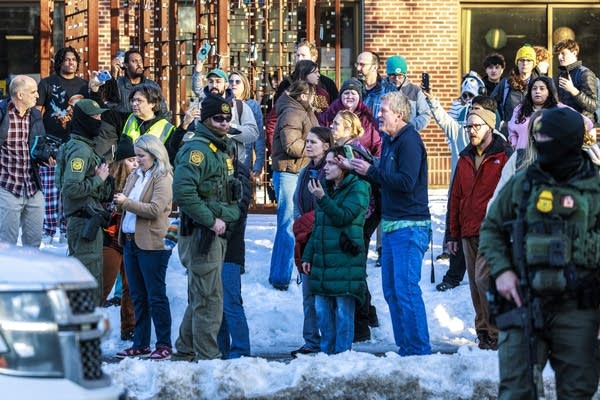
At one stop in January, Stanke said a “heavy presence” of federal agents frightened families and staff so much they sent a school bus of children back to the elementary school building for 45 minutes until agents left.
“As a principal, this time has been trying. Focus inevitably shifted from instructional leadership to what could be best described as crisis management,” Stanke said. “Responding to this operation was not a chapter in my principal playbook.”
Student mental health remains a top concern
The surge is not the only difficulty Minnesota school leaders say they are responding to. The third installation in a yearslong project to survey school principals statewide finds many such educational leaders remain overwhelmed, concerned about students’ mental health and struggling to find time to lead instruction.
Part of the issue, according to a 2025 survey of more than 1,000 Minnesota principals, is that school leaders are spending more time on administrative tasks and less time on instructional leadership.
Another issue is that student needs continue to overwhelm school staff.
“I became a principal because I have passion for being an instructional leader, working alongside teachers to improve learning for students,“ said LeMier, the Park Rapids principal. “Yet the Minnesota principal survey consistently shows that principals lack the time to lead instruction.”
He said in his 11 years working in school administration he has consistently seen an increase in the “frequency, intensity and duration of students who are disregulated” in his pre-K through sixth grade classrooms.
“It is common for multiple adults, administrators, special education staff, para professionals and even our school resource officer to spend hours working with a single student in crisis,” LeMier said.
Many of LeMier’s colleagues echoed his concerns. When asked to name their greatest challenge, the highest number of survey respondents pointed to addressing student mental health challenges.
They also reported spending an average of 43 percent of their workday on student behavior and 80 percent said responding to student behavior interferes with their ability to carry out other leadership responsibilities.
Challenging student behavior has “become more prevalent in the last few years” and is “a significant barrier to student learning and it’s having a pretty negative impact on staff morale,” said Katie Pekel, executive director of educational leadership at the University of Minnesota.
The next most challenging issue principals named was addressing chronic absenteeism — an issue schools have described as especially acute since the pandemic.
Principals surveyed said they believed the top reason students were absent was related to student mental health, closely followed by a lack of concern from parents about attendance and by students not wanting to be at school.
“This has become an increasingly concerning area in the state of Minnesota,” Pekel told lawmakers.