As a founder, hiring someone with an impressive brand on their CV is tempting.
However, hiring an exec from Big Tech is a known anti-pattern in startup hiring.
Despite their impeccable interview style and flawless references, Big Tech execs often fail when thrown into the chaos of an early-stage role.
Here are three non-obvious reasons why this happens so often.
1. Price’s Law
Derek J. de Solla Price was a science historian obsessed with measuring productivity.
In his 1963 book,Little Science, Big Science, he observed that over half of the published research in a scientific field came from a tiny proportion of the scientists.
This became known as Price’s Law, and the pattern generalises beyond science:
Half the output comes from the square root of the participants.
You see this in sports. The top 10 tennis players take over half of the titles. And even among the top 10, three of them win most often—Alcaraz, Sinner, Zverev.
You see this in music. Most of the listens on Spotify come from a small number of musicians—Taylor Swift, Bad Bunny, and Drake.
And you see this within businesses too:
In a 10-person company, 3 people generate over half the results.
In a 100-person company, it’s around 10 people.
In a 10,000-person company, just 100 people drive over 50% of the output.
I shared this formula at one of my recent CEO intensives, and watched my founders get out their calculators to work out the square root of their headcount. One by one, they all nodded in agreement.
So when you hire talent from a big company with over 10,000 people, the chance you’re hiring one of their top performers is dishearteningly low. The distribution of performance is wildly uneven.
How to mitigate: Reference the candidate with someone you already know is a top performer. Without a strong network of your own, you’ll have to rely on their references which is less reliable.
2. Unearned Scale Advantages
If a big company isn’t full of competent people, how did they scale?
Often, the difficulty of scaling talent is offset by the advantages of scale.
Not every business gets better with scale. Indeed, companies that rely heavily on human competence to deliver value (agencies, consulting, services) often get worse with scale (at least before AI came along).
But Big Tech is different. Successful tech products get better with scale, and there are a few drivers of this:
Network Effects: New users of the product make it more valuable for existing users (e.g. social networks, marketplaces, and communication tools).
Economies of Scale: Scale leads to lower costs that can be passed to the customer (e.g. Netflix can spread the cost of exclusive TV shows across millions of viewers).
Brand Power: Buyers place a premium on safety, trust, and status when making a purchase (e.g. “No one ever got fired for buying IBM”).
This makes it extremely hard to separate the contributions of the individual from the advantages of working for an at-scale company.
How to mitigate: Check when they joined and at what scale. If they joined after the size you’re at now, discount their contributions accordingly.
3. Already Established Systems
Even when you find a high performer, you can’t assume they’ll perform as well atyourcompany.
We tend to think of performance as an individual quality. But it’s also a function of the systems someone operates within. A top-performing Sales Development Rep (SDR) at one company can fail at another with weaker systems.
It’s helpful to group execs into two buckets: builders andoperators.
Builders thrive when they get to build systems from scratch. Operators thrive when they get to run systems that already exist.
Big Tech companies have well-developed systems across the board:
Org Systems:clear roles and responsibilities.
IP Systems:playbooks, checklists, and training.
IT Systems:automations and workflows.
Cultural Systems:rituals and shared language.
This means most Big Tech execs are operators who got results by running systems someone else built.
But in an early-stage company, the systems don’t exist yet and you need someone to build them. And that’s a different kind of person.
How to mitigate: First figure out whether you need a builder-type to create a system, or an operator-type who can operate the system you already have. Thenassess their profile using this guide.
Brand Names Can Hide Weak Performers
There are real advantages to hiring from Big Tech. They’ve seen what good looks like at scale, they bring pattern recognition from inside mature systems, and they come with networks and credibility you can borrow.
But there are also drawbacks worth knowing, so you can ask better questions at interview and debunk some of your false assumptions.
Ultimately, working at a brand doesn’t make you a top performer.
And there’s a bigger lesson in this for you.
As you scale, you can’t rely on competence alone. Make sure you’re building products that get better with scale and systems that turn average performers into great ones.
Because the only way to build a company of A-players is to find ways to make everyone’sjob easier.
Related Reading:
Originally published on May 13th, 2026
How do top founders actually scale?
I’ve coached CEOs for 10,000+ hours—here’s what works. Join 17,000+ founders learning how to scale with clarity.
The recurring gag was that McLaughlin would ask the guests a serious political question, each would give a thoughtful answer, and McLaughlin would shout “WRONG!”
I think about that a lot when I’m doing deposition preparation with clients in trade secrets lawsuits.
Let’s go over some common ways defendants in trade secrets lawsuits go wrong in their depositions. We’ll use our old hypothetical friend Dawn Davis as an example
1. Are the things defined as “confidential information” or “trade secrets” in the agreement actually confidential or secret?
Like most employment agreements, Dawn’s agreement with Paula Payne Windows includes a confidentiality agreement.
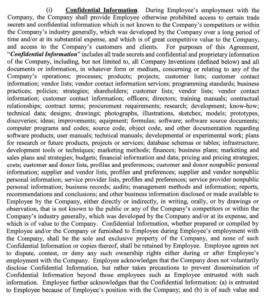
The definition of “confidential information” looks something like this:
The deposition questions about it go something like this:
Q: Can you take a look at the definition of the company’s “confidential information and trade secrets” in your agreement? Do you see that?
A: Yes.
Q: You signed this agreement, right?
A: Yes, I signed it.
Q: So you agree that the things listed in this definition are the company’s confidential information, right?
A: Right.
WRONG!
What a difference a single letter can make.
If the question was “you agreed that the things listed in the definition are the company’s confidential information,” then yes would be an acceptable answer. That’s because generally, if you sign an agreement, you agreed to what’s in it.
But just because you signed the agreement doesn’t mean you now agree with every statement in the agreement.
See the distinction?
Yes, you may have agreed to what’s in the agreement by signing it, but just because the agreement says something is true doesn’t make it true.
Especially when it comes to a definition of “confidential information” or “trade secrets.”
The problem with this definition—and most definitions of confidential information in such agreements—is that it is both too vague and too broad.
These are slightly different things.
The definition is vague, or “indefinite,” because it is not clear what is included and what is not. For example, the definition refers to the company’s “processes” and “policies.” Which processes and policies? All of them, or just the “confidential” ones? And which ones are confidential?
Let’s say Paula Payne Windows has a process for prospecting for new customers: search on the internet for the kind of companies that buy windows, find the contact information for the person there responsible for buying windows, cold call that person, then make a note in the company’s CRM system to follow up later.
That’s a process, but is it a confidential process? Of course not. Everybody has a process like this. It’s no secret.
Is that process included in the contract’s definition of “confidential information”? It’s hard to say.
But you could read the definition literally to mean that all of the company’s processes are included in the definition of confidential information. And that brings up the second problem: the definition is overbroad.
The definition is overbroad because on its face it includes things that are not confidential.
An agreement that defines all of the company’s information as confidential would be unreasonable and unenforceable. It would be a de facto non-compete.
When you understand these two problems, you can answer deposition questions more accurately.
Q: So you agree that the things listed in this definition are the company’s confidential information, right?
A: Not necessarily.
Q: Why not?
A: Well, first, I’m not even sure what this definition means. And second, it has things in it that are obviously not confidential information.
Q: Like what?
A: Like “processes” and “policies.” If that means all of the company’s processes and policies, then it includes things that are obviously not a secret.
This answer won’t make the questioning lawyer happy, but you’re not there to make friends.
2. Is a customer list a trade secret?
Suppose when Dawn Davis left Paula Payne Windows, she took an Excel spreadsheet showing all her sales from the previous year, including the names of the customers. Dawn says she needed the list because the company owed her commissions, but Paula Payne Windows says the spreadsheet is a confidential customer list.
So the deposition questioning goes like this:
Q: You’re not a lawyer, are you?
A: No.
Q: Ok, I’m not asking for a legal opinion or anything, but do you see this definition of “trade secrets” from the Texas Uniform Trade Secrets Act?
A: Yes.
Q: The definition includes “list of actual or potential customers,” right?
A: Yes, I see that.
Q: [in the most casual tone possible] Ok, so you understand a customer list is a trade secret, right?”
A: Yes, I understand that.
WRONG!
Perhaps we can forgive Dawn for making this mistake. I have seen licensed lawyers make this very argument to judges. “Your Honor, the definition of trade secrets in TUTSA specifically includes customer lists, so my client’s customer list is a trade secret.”
But the argument is wrong, for two reasons.
First, if you look at the whole definition of a trade secret, there’s a very important word: “if.”
A customer list is included in the list of types of things that can be a trade secret, if the rest of the elements of the definition are met (like “independent economic value”).
The first problem with the deposition question was that it ignored this important “if.”
The second problem with the argument is that it just defies common sense.
Think about it. Suppose Dawn’s spreadsheet lists just five customers, who happen to be the biggest homebuilders in her sales territory. There’s no way that’s a trade secret. All the competitors in that area know who those customers are.
If you want to know more, I cover this issue in more detail at my blog post When Is a Customer List a Trade Secret. I even cite court cases. But you get the idea.
Now that Dawn is armed with the knowledge that a customer list isn’t automatically a trade secret, let’s give her another crack at the deposition question:
Q: Ok, so you understand a customer list is a trade secret, right?”
A: No.
Q: But it says that right there in the definition, doesn’t it?
A: It says customer list, but there’s more to the definition.
Q: So you don’t think your customer list is a trade secret?
A: No. Everybody in our industry knows who those customers are.
Now that we’ve avoided that confusion, let’s look at another category of information that can be a trade secret but isn’t necessarily a trade secret: prices.
Here’s how the lawyer for Paula Payne Windows might try to set it up in Dawn’s deposition:
Q: Are you working for Real Cheap Windows now?
A: Yes.
Q: Let’s say a competitor calls you up and asks you for the prices you’re charging customers this week, would you tell him?
A: Uh . . . I don’t think that has ever happened.
Q: But if it did, would you tell them?
A: I mean, I don’t think so.
Q: Why not?
A: Well it’s none of their business.
Q: And if they knew your prices they could offer the same customers lower prices, right?
A: That could happen.
Q: Can your competitors just do a Google search and find your prices?
A: No.
Q: Right, so the prices your company charges its customers are confidential, right?
A: Yeah, I guess so.
WRONG!
Don’t let this happen in your deposition
Everything leading up to the last question is fine, but are the prices really a secret?
Nine times out of ten, the answer will be no, at least in my experience and opinion.
That’s because in the vast majority of cases, there’s nothing to stop the customers from telling one competitor what another competitor is charging.
In fact, in many industries, it’s common for customers to do so. “Hey, Fred, Bubba’s Oilfield Supply says it can get me those frac valves for five thousand apiece this week, can you beat that?”
Unless the company has a nondisclosure agreement with the customer that says the customer must keep the company’s prices confidential, I don’t see how the company can genuinely claim the prices are a secret, or that it took the required “reasonable measures” to keep the prices secret.
Keep in mind, this is just my opinion. But it is usually correct.
Knowing that, here’s a better way for Dawn to answer deposition questions about prices:
Q: So the prices your company charges its customers are confidential, right?
A: No.
Q: They’re not confidential? Are you saying you would just give them out to your competitors?
A: I didn’t say that.
Q: Well, if the prices aren’t confidential, why wouldn’t you share them?
A: They can easily go and ask my customer for the prices, and I can’t stop the customer from telling them. But that doesn’t mean it’s my job to help them.
So, those prices on the spreadsheet Dawn took from Paula Payne Windows, maybe they’re not so secret.
That, of course, does not mean it was a good idea for Dawn to take the spreadsheet.
4. What does the forensics show?
It’s a bad idea for departing employees to take or keep any company documents.
With the exception of their agreements with the company, which I think are generally fair game for an employee to keep. But generally, don’t take company documents when you leave!
There are multiple reasons for this, but maybe the most important one is that whatever documents the employee takes, those will be the documents the company claims contain its alleged “trade secrets” in the subsequent trade secrets lawsuit. I call this Wolfe’s First Law of Trade Secrets Litigation.
Here’s how it might go down in Dawn’s case:
Q: When you were working for Paula Payne Windows, did they provide a computer?
A: Yeah, I had a computer at the office.
Q: Did you ever use USB drives?
A: You mean like a thumb drive?
Q: Yes.
A: Sure, we used those all the time, like if I needed to take documents with me on a customer visit.
Q: Let me show you Plaintiff’s Exhibit 13 to your deposition. That’s a report our forensic expert prepared. Do you see that?
A: Yes.
Q: Do you see line 7 on page 2 that shows on April 7, 2023, the day after you gave notice, you plugged a Seagate thumb drive into your computer at work and copied 12 sales reports to it?
A: Yes.
WRONG!
Dawn doesn’t have any personal knowledge of the forensic report or how it was prepared. And her recollection is probably not that specific. How can she be sure?
Here’s a better way for Dawn to answer:
Q: Do you see line 7 on page 2 that shows you copied 12 files on to a thumb drive?
A: I didn’t prepare this report.
Q: Ok, but you see where it says that, right?
A: I see that the report says that.
Q: Well, are you denying that you copied 12 files on to that thumb drive on April 7, 2023?
A: I’m not denying there were times when I put files on a thumb drive, but I can’t remember if I copied those specific files on that specific date.
Q: Ok, but you can’t rule it out?
A: I can’t rule it in or out. I just don’t remember.
Sticking to what you personally know is good deposition advice generally, but especially when it comes to computer forensics in a trade secrets lawsuit.
Let me stress: I am not saying Dawn should pretend like she doesn’t know or doesn’t remember if she does remember. Every witness should tell the truth. If Dawn clearly remembers, “yes, I copied 12 files on to a thumb drive on April 7, 2023,” then she should say so.
But it’s rare that the witness will remember that specifically.
In most cases, a witness in a deposition is not going to remember every little thing she did on a computer years earlier, before any lawsuit was filed. She certainly won’t remember things like the serial number of the USB drive.
And that brings up the final common deposition mistake to avoid in a trade secrets lawsuit.
5. Undermining your credibility by overstating your case
Maintaining your credibility is critically important in any lawsuit.
And if you’re a former employee defendant in a trade secrets lawsuit, it is even more important than usual. Right off the bat your credibility is under attack because you did something your former employer portrays as sneaky and underhanded. “Theft!” they will cry.
And you should expect the plaintiff’s lawyer will go into the deposition ready to set you up. It might go like this:
Q: Can you take a look at page 27 of the Paula Payne Windows Employee Handbook?
A: Ok, yes, I’m there.
Q: It says “Employees must take care not to disseminate company documents outside the company, such as sending them to personal email addresses.” Did I read that correctly?
A: Nobody ever paid attention to that.
Q: Ok, but that was the company’s stated policy, correct?
A: Yeah, I guess.
Q: Ok, so you knew it was against company policy to email yourself company documents, right?
A: Right.
Q: Did you ever do that?
A: Absolutely not. I never emailed myself company documents.
WRONG!
The answer is wrong because you already know what’s coming next: Impeachment.
The lawyer for Paula Payne Windows will show Dawn a copy of an email from her company email account to her personal Gmail account attaching a proposal to a customer.
“Oh, I forgot about that!” Dawn will say. “I was going to meet with a customer out of the office the next day, and I needed to be able to print out the proposal at home.”
A legitimate explanation, if true. But the damage will already be done.
So for questions like this, it’s important to be cautious and not overstate your case.
In this example, there are basically three possibilities:
Dawn remembers emailing herself the proposal, or at least remembers emailing herself generally.
Dawn has no recollection of emailing herself company documents, but knows it’s possible she did.
Dawn knows for a fact she never emailed company documents to herself.
If 1 is true, then Dawn should say so.
If 2 is true, then Dawn should say something like “I don’t have a specific memory of doing that.” Then she’s leaving room for the possibility that it happened.
If 3 is true, then Dawn could say she never emailed herself company documents, but even then, she should proceed with caution.
You see, memory is a funny thing. Every litigator has experienced a client who was 100% sure of some fact or sequence of events, and then the documents show her memory is just flat wrong.
So even if Dawn is absolutely sure, it’s still a good idea to say something like “I don’t think I ever did that.”
You don’t need to overstate the good facts that are on your side.
On a scale of 1 to 14, 1 being lowest degree of likelihood, 14 being absolute metaphysical certitude, what are the chances you’ll make a mistake?
Go ahead, say your answer.
WRONG!
_______________________
Zach Wolfe (zach@zachwolfelaw.com)is a Texas trial lawyer who handles non-compete and trade secret litigation at Zach Wolfe Law Firm (zachwolfelaw.com). Thomson Reuters has named him a Texas Super Lawyer® for Business Litigation every year since 2020.
These are his opinions, not the opinions of his firm or clients, so don’t cite part of this post against him in an actual case. Every case is different, so don’t rely on this post as legal advice for your case.
To provide the best experiences, we use technologies like cookies to store and/or access device information. Consenting to these technologies will allow us to process data such as browsing behavior or unique IDs on this site. Not consenting or withdrawing consent, may adversely affect certain features and functions.
Functional
Always active
The technical storage or access is strictly necessary for the legitimate purpose of enabling the use of a specific service explicitly requested by the subscriber or user, or for the sole purpose of carrying out the transmission of a communication over an electronic communications network.
Preferences
The technical storage or access is necessary for the legitimate purpose of storing preferences that are not requested by the subscriber or user.
Statistics
The technical storage or access that is used exclusively for statistical purposes.The technical storage or access that is used exclusively for anonymous statistical purposes. Without a subpoena, voluntary compliance on the part of your Internet Service Provider, or additional records from a third party, information stored or retrieved for this purpose alone cannot usually be used to identify you.
Marketing
The technical storage or access is required to create user profiles to send advertising, or to track the user on a website or across several websites for similar marketing purposes.