
The Dividend Aristocrats 2026 are U.S. stocks that have increased their dividend for 25+ years. However, this factor alone does not qualify a stock as a Dividend Aristocrat. To be included on the list, a company must meet five criteria.
- Be a member of the S&P 500 Index
- Have raised the regular dividend per share for at least 25 consecutive years
- Have a market capitalization of at least $3 billion
- Average at least $5 million in daily share trading value for the three months before the rebalancing date
- The minimum number of constituents must be 40 at each rebalancing date. In addition, a particular Global Industry Classification Standard or ‘GICS’ should only result in one sector comprising up to 30% of the index weight.
The Index is updated quarterly in January, April, July, and October.
These stocks are found in the S&P 500 Dividend Aristocrats Index. Currently, there are 69 stocks in the Dividend Aristocrats.
Investors can examine updated, select financial data and the dividend earnings calendar for each stock in the Dividend Aristocrats list in the tables at the end of the article. The most recent dividend increases are also available to search.
Affiliate
Stock Rover is an award winning investment research platform.
- The site has 8,500+ stocks, 4,000 ETFs, and 40,000 mutual funds.
- Access to 650+ metrics, financial data, market news, stock and fund ratings, fair value, margin of safety, etc.
- Includes brokerage integration, portfolio tracking, rebalancing, watchlists, alerts, future income forecasts, etc.
Click here to try Stock Rover for free (14-day free trial).
Market Update for the Dividend Aristocrats 2026
The Dividend Aristocrats 2026 yields about 2.64%, and the average forward price-to-earnings ratio is approximately 17.75X. The trailing P/E ratio is 25.24X.
The mean market capitalization is roughly $110,280 million, and the median is approximately $40,851 million. The market cap ranges between about $7,413 million and $990,532 million. The total market capitalization is roughly $7,609,835 million.
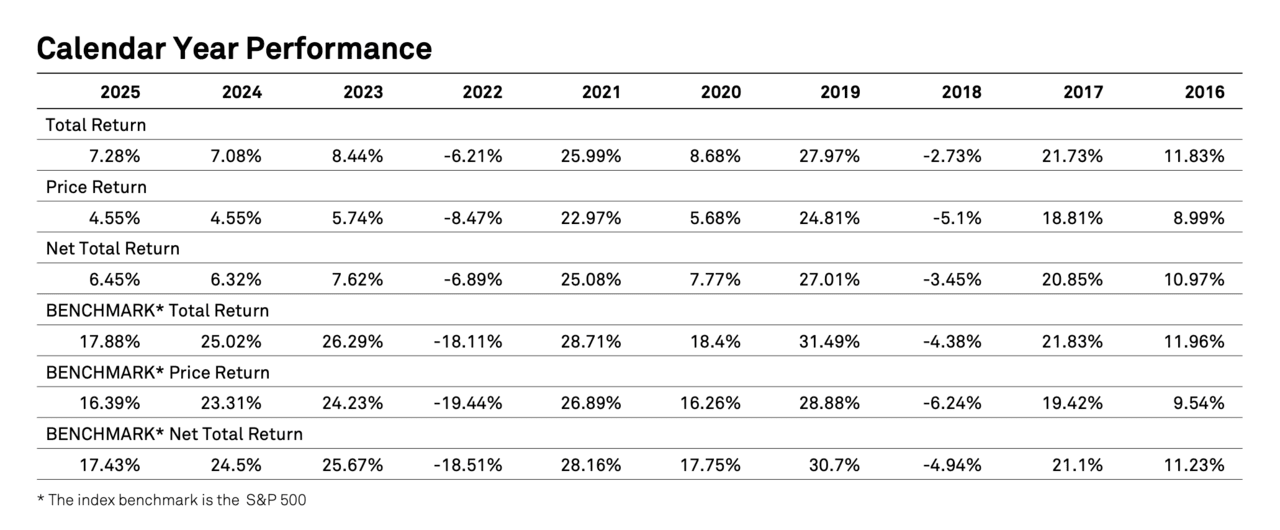
In 2025, the Dividend Aristocrats provided a total return of 7.28% after a similar positive return in 2024. The price return was 4.55%. This performance was less than the S&P 500 Index in 2025 at 17.88%.
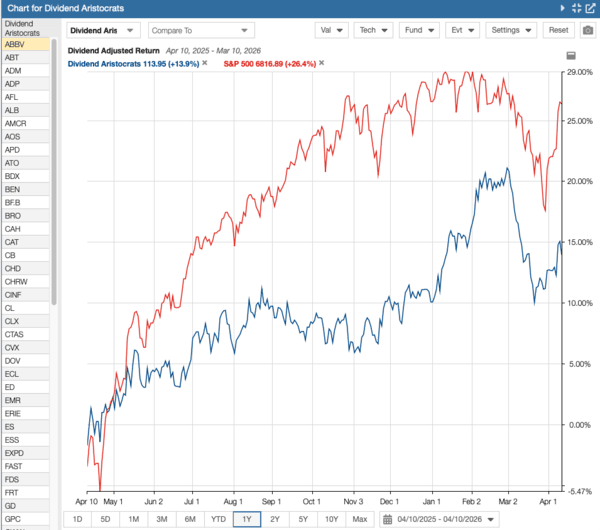
In the trailing 1-year, the Dividend Aristocrats 2026 returned +13.9% (blue line) compared to +26.4% for the S&P 500 Index (red line), as seen in the chart below. We used Stock Rover* to create this watchlist and chart. Over the trailing 5-years, the Dividend Aristocrats have returned +48.5%, and the S&P 500 Index has returned +78.2%.
Difference Between Dividend Champions and Aristocrats
A Dividend Aristocrat can also be a Dividend Champion but not vice-versa. For instance, Arrow Financial Corporation (AROW) does not meet all the above criteria; thus, it is not a Dividend Aristocrat. However, Arrow has raised the dividend for 31 years, permitting it to be on the Dividend Champions list. As a result, there are more Dividend Champions than Dividend Aristocrats.
Historical Performance
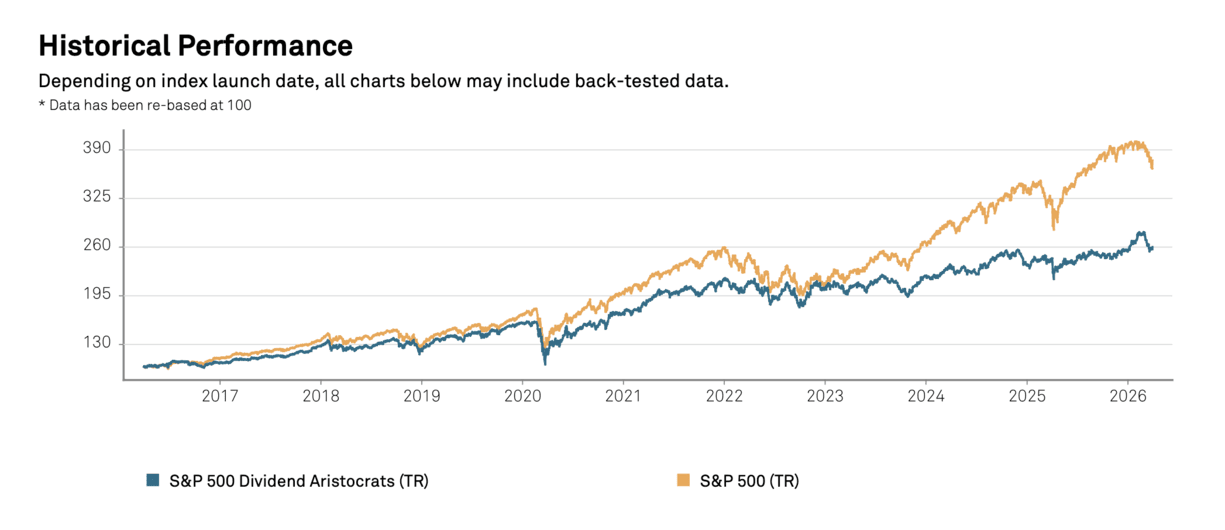
As a group, the S&P 500 Dividend Aristocrats have exhibited solid returns with low volatility. For example, the Dividend Aristocrats had annualized total returns of 10.03% over the past decade and a standard deviation of 14.95%. On the other hand, the benchmark (the S&P 500 Index) had annualized total returns of 14.16% and a standard deviation of 15.02%. However, since the pandemic, the mega cap technology stocks have outperformed the Dividend Aristocrats by a large margin resulting in this discrepancy.
Over the past 5-years, the Dividend Aristocrats had an annualized total return of 6.8% with a standard deviation of 15.28%. The benchmark had an annualized total return of 12.06% and a standard deviation of 15.26%.
The table below shows the calendar year’s performance from 2016 to 2025.
Changes to the Dividend Aristocrats in 2026
No changes occurred at the start of the year to the constituents of the list.
Other Dividend Stock Lists
Note that a company can be a Dividend Aristocrat and a Dividend King. Dividend Kings have raised dividends for at least 50 consecutive years. The other lists of American stocks are below.
For Canadian stocks, there is an article
For UK stocks, there is an article
Other dividend stock lists
Some Details on the Dividend Aristocrats 2026
The Dividend Aristocrats 2026 is a reasonably select list since there are only 69 companies. This number is out of nearly 6,000 companies listed on the New York Stock Exchange (NYSE) and NASDAQ in 2026, indicating a success rate of approximately 1.2%.
Dividend Aristocrats Sector Breakdown
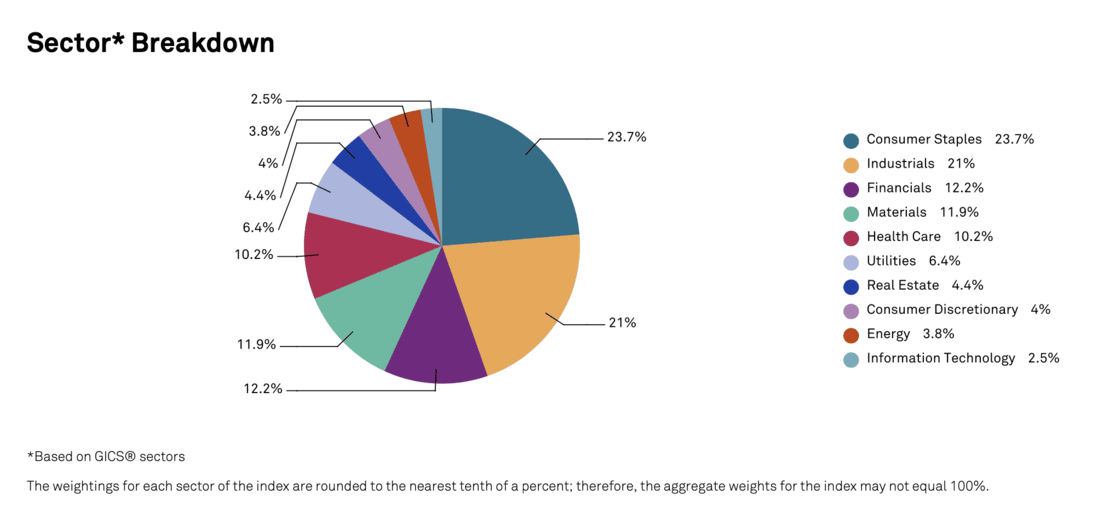
The sector with the highest representation of the Dividend Aristocrats 2026 is Consumer Staples, approximately 23.7%. This point is likely due to these stocks’ relatively stable earnings and cash flow characteristics. In addition, these companies tend to grow profits slowly over time, permitting annual dividend increases.
Stocks from the Industrials sector have the second-highest representation on the Dividend Aristocrats 2026 at about 21%. This class of stocks tends to have more volatile earnings and cash flows, but many have low payout ratios, allowing them to grow their dividends during recessions and economic downturns.
The third sector on the list is the Financials sector at 12.2%. These firms are able to raise their dividends because of sound balance sheets and growing top and bottom lines.
These three sectors comprise the majority of the Dividend Aristocrats at 56.9%.
Only Three REITs
Only three Real Estate Investment Trusts (REITs) exist in the Dividend Aristocrats. These are Essex Property Trust (ESS), Federal Realty Investment Trust (FRT), and Realty Income (O). In addition, the list does not include any Master Limited Partnerships (MLPs).
Related Articles About REITs on Dividend Power
Sector Breakdown
The sector breakdown for the Dividend Aristocrats 2026 is seen in the chart below. Because of the composition changes in the S&P 500 Index, the sector composition has changed with time. In addition, the Great Recession caused many previous Dividend Aristocrats to freeze or even cut their dividends. As a result, these primarily financial stocks were dropped from the list of Dividend Aristocrats, affecting the sector composition.
A few industrial stocks were also dropped from the list at the time. In fact, between 2009 and 2010, nineteen companies were dropped from the list of Dividend Aristocrats.
The sector ranking for the Dividend Aristocrats 2026 is unlike the Canadian Dividend Aristocrats, which have Financials, Industrials, and Real Estate as the top three sectors.
It is also unlike the UK High Yield Dividend Aristocrats, with Financials, Real Estate, and Industrials as the top three sectors.
Sector Allocation History
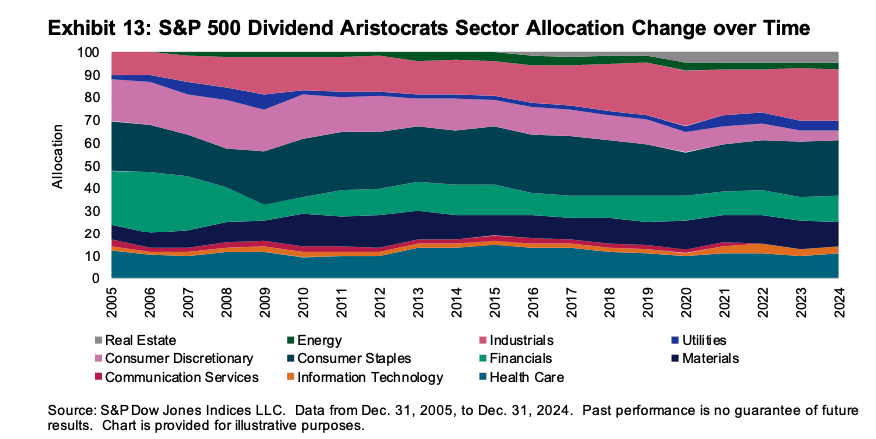
The chart below shows the sector allocation over time. Consumer Staples has consistently maintained its lead over time. The sector allocation changes because of economic events.
For example, the Great Recession caused many previous Dividend Aristocrats to freeze or even cut their dividends. As a result, these primarily financial stocks were dropped from the list of Dividend Aristocrats, affecting the sector composition. A few industrial stocks were also dropped from the list at the time. In fact, between 2009 and 2010, nineteen companies were dropped from the list of Dividend Aristocrats. More recently, some additional industrial and retail firms were removed because of dividend cuts during the COVID-19 pandemic and because of divestments.
Market Size of the S&P 500 Dividend Aristocrats 2026
The largest Dividend Aristocrat by market capitalization is Walmart (WMT), with roughly $1,010 billion market capitalization. The smallest Dividend Aristocrat is Factset Data & Stock Exchanges (FDS), with a $7.708 billion market capitalization. The Dividend Aristocrats have a total market capitalization of over $6 trillion.
The one with the highest forward yield is Amcor (AMCR), and the one with the lowest dividend yield is West Pharmaceuticals (WST).
Dover Corporation (DOV) is the Dividend Aristocrat with the longest streak of consecutively increasing the dividend at 70 years. It is followed by Genuine Parts Company (GPC), Northwest Natural Holding Company (NWN), and The Procter & Gamble Company (PG)
List of Dividend Aristocrat Stocks in 2026
The Dividend Aristocrat 2026 list serves as a screen for further investigating a stock for a dividend growth portfolio. It is a list of companies with stable businesses that have competitive advantages and have returned cash to shareowners consistently through dividends and, in some cases, buybacks.
Stock Rover* was used to create this table.
| Ticker | Company | Fwd. Yield | EPS 5-Year Avg (%) | Dividend 10-Year Avg (%) | Payout Ratio | Forward P/E | Market Cap ($M USD) |
|---|---|---|---|---|---|---|---|
| ABBV | AbbVie | 3.30% | -2.50% | 11.70% | 276.80% | 12.9 | $367,796 |
| ABT | Abbott Laboratories | 2.50% | 3.10% | 9.30% | 63.30% | 16.4 | $174,288 |
| ADM | Archer-Daniels-Midland | 3.00% | -9.50% | 5.70% | 91.50% | 14.4 | $33,602 |
| ADP | Automatic Data Processing | 3.60% | 12.60% | 12.40% | 60.50% | 15.8 | $76,015 |
| AFL | Aflac | 2.20% | -2.50% | 11.50% | 33.90% | 14.3 | $57,030 |
| ALB | Albemarle | 0.90% | – | 2.90% | – | 20.1 | $20,469 |
| AMCR | Amcor | 6.30% | -13.60% | – | 192.00% | 9.4 | $19,017 |
| AOS | A.O. Smith | 2.10% | 9.90% | 11.60% | 35.70% | 15.2 | $9,112 |
| APD | Air Products | 2.40% | – | 7.70% | – | 21.3 | $66,509 |
| ATO | Atmos Energy | 2.10% | 7.00% | 9.10% | 46.50% | 21.6 | $31,492 |
| BDX | Becton Dickinson | 2.70% | 1.80% | 4.80% | 68.10% | 11.4 | $43,870 |
| BEN | Franklin Resources | 5.30% | -12.90% | 6.20% | 119.40% | 8.7 | $12,972 |
| BF.B | Brown-Forman | 3.10% | -2.00% | 5.40% | 52.90% | 17.4 | $13,551 |
| BRO | Brown & Brown | 1.00% | 11.30% | 10.40% | 18.30% | 13.1 | $22,098 |
| CAH | Cardinal Health | 1.00% | 12.20% | 2.80% | 29.20% | 18.6 | $50,715 |
| CAT | Caterpillar | 0.80% | 24.60% | 7.00% | 30.90% | 28.5 | $367,884 |
| CB | Chubb | 1.20% | 15.80% | 3.80% | 14.70% | 11.3 | $127,389 |
| CHD | Church & Dwight Co | 1.30% | -0.40% | 5.60% | 38.80% | 23.8 | $22,602 |
| CHRW | C.H. Robinson Worldwide | 1.50% | 1.70% | 3.90% | 51.00% | 22.9 | $19,267 |
| CINF | Cincinnati Financial | 2.20% | -4.30% | 7.00% | 22.70% | 17.5 | $25,087 |
| CL | Colgate-Palmolive | 2.50% | -3.30% | 3.20% | 78.00% | 20.5 | $67,666 |
| CLX | Clorox | 4.70% | -3.20% | 4.90% | 80.10% | 15.7 | $12,729 |
| CTAS | Cintas | 1.00% | 15.70% | 18.40% | 36.20% | 32.3 | $69,987 |
| CVX | Chevron | 3.80% | – | 5.20% | 102.90% | 18.5 | $375,572 |
| DOV | Dover | 1.00% | 9.30% | 2.20% | 25.90% | 18.9 | $29,267 |
| ECL | Ecolab | 1.00% | 19.10% | 7.60% | 36.60% | 28.3 | $77,183 |
| ED | Consolidated Edison | 3.00% | 10.80% | 2.90% | 60.10% | 17.5 | $41,837 |
| EMR | Emerson Electric | 1.50% | 2.90% | 1.60% | 52.00% | 20.1 | $80,798 |
| ERIE | Erie Indemnity | 2.30% | 12.60% | 7.20% | 46.30% | – | $13,345 |
| ES | Eversource Energy | 4.50% | 4.80% | 5.90% | 66.00% | 13.7 | $26,297 |
| ESS | Essex Property Trust | 4.10% | 9.80% | 4.90% | 98.90% | 40.7 | $16,123 |
| EXPD | Expeditors International | 1.10% | 3.40% | 7.90% | 25.80% | 21.9 | $19,024 |
| FAST | Fastenal | 1.80% | 7.60% | 12.30% | 79.60% | 36.2 | $56,463 |
| FDS | FactSet Research Systems | 2.10% | 9.10% | 9.60% | 28.10% | 10.9 | $7,708 |
| FRT | Federal Realty Investment | 4.10% | 25.20% | 1.90% | 95.30% | 34.3 | $9,420 |
| GD | General Dynamics | 1.80% | 6.90% | 7.70% | 38.30% | 18.6 | $90,773 |
| GPC | Genuine Parts | 4.00% | -23.40% | 4.90% | 876.60% | 12.6 | $14,957 |
| GWW | W.W. Grainger | 0.80% | 20.20% | 6.80% | 24.90% | 24.1 | $55,474 |
| HRL | Hormel Foods | 5.70% | -11.30% | 7.30% | 130.60% | 13.1 | $11,323 |
| IBM | IBM | 2.90% | 13.60% | 2.60% | 59.10% | 17.2 | $216,547 |
| ITW | Illinois Tool Works | 2.40% | 8.50% | 11.30% | 59.10% | 22.3 | $77,930 |
| JNJ | Johnson & Johnson | 2.20% | 14.30% | 5.70% | 46.20% | 19 | $574,357 |
| KMB | Kimberly-Clark | 5.30% | -6.10% | 3.40% | 82.80% | 12.7 | $32,289 |
| KO | Coca-Cola | 2.70% | 12.70% | 4.20% | 66.90% | 22.4 | $333,442 |
| KVUE | Kenvue | 4.80% | – | – | 108.60% | 14.3 | $33,255 |
| LIN | Linde | 1.30% | 21.60% | 7.90% | 40.80% | 25.8 | $233,156 |
| LOW | Lowe’s Companies | 2.00% | 8.90% | 15.70% | 40.00% | 17.9 | $136,778 |
| MCD | McDonald’s | 2.40% | 11.60% | 7.60% | 59.80% | 21.3 | $217,285 |
| MDT | Medtronic | 3.30% | 10.90% | 6.50% | 78.60% | 14.4 | $111,967 |
| MKC | McCormick & Co | 3.60% | 16.50% | 8.40% | 29.90% | 16.1 | $14,444 |
| NDSN | Nordson | 1.20% | 14.50% | 13.10% | 34.50% | 22.2 | $15,356 |
| NEE | NextEra Energy | 2.70% | 9.30% | 11.10% | 68.50% | 21.5 | $196,185 |
| NUE | Nucor | 1.20% | 6.90% | 4.10% | 29.40% | 13.9 | $42,386 |
| O | Realty Income | 5.10% | 4.00% | 3.10% | 275.50% | 36.3 | $59,443 |
| PEP | PepsiCo | 3.60% | 2.10% | 7.30% | 93.40% | 17.2 | $214,691 |
| PG | Procter & Gamble | 2.90% | 4.40% | 4.80% | 60.50% | 19.9 | $337,351 |
| PNR | Pentair | 1.20% | 9.60% | -2.00% | 25.10% | 15.5 | $14,578 |
| PPG | PPG Indus | 2.60% | 6.70% | 7.00% | 39.90% | 12.9 | $24,691 |
| ROP | Roper Technologies | 1.10% | 8.50% | 11.70% | 23.10% | 14.7 | $35,129 |
| SHW | Sherwin-Williams | 1.00% | 5.80% | 11.10% | 30.50% | 25.1 | $83,140 |
| SJM | JM Smucker | 4.80% | – | 5.10% | – | 11.2 | $9,695 |
| SPGI | S&P Global | 0.90% | 7.60% | 10.40% | 26.20% | 18.8 | $122,955 |
| SWK | Stanley Black & Decker | 4.60% | -23.10% | 4.20% | 124.10% | 11.4 | $11,210 |
| SYY | Sysco | 3.00% | – | 5.70% | 57.10% | 14.5 | $34,820 |
| TGT | Target | 3.70% | -1.20% | 7.40% | 55.40% | 14.3 | $55,198 |
| TROW | T. Rowe Price Group | 5.70% | -4.70% | 9.20% | 54.90% | 9.3 | $19,908 |
| WMT | Walmart | 0.80% | 11.50% | 4.00% | 34.30% | 38.6 | $1,010,661 |
| WST | West Pharmaceutical Servs | 0.30% | 4.00% | 6.20% | 12.50% | 28.9 | $18,492 |
| XOM | Exxon Mobil | 2.70% | – | 3.50% | 59.70% | 16 | $633,916 |
Dividend Calendar
This table was created using StockRover*.
| Ticker | Company | Ex-Div. Date | Div. Record Date | Div. Payment Date | Dividend Frequency | Next Div. Payment Per Share | Fwd. Div. Per Share |
|---|---|---|---|---|---|---|---|
| WST | West Pharmaceutical Servs | 4/29/26 | 4/29/26 | 5/6/26 | 4 | $0.22 | $0.88 |
| CAT | Caterpillar | 4/20/26 | 4/20/26 | 5/19/26 | 4 | $1.51 | $6.04 |
| GWW | W.W. Grainger | 2/9/26 | 2/9/26 | 3/1/26 | 4 | $2.26 | $9.04 |
| WMT | Walmart | 5/8/26 | 5/8/26 | 5/26/26 | 4 | $0.25 | $0.99 |
| ALB | Albemarle | 3/13/26 | 3/13/26 | 4/1/26 | 4 | $0.41 | $1.62 |
| SPGI | S&P Global | 2/25/26 | 2/25/26 | 3/11/26 | 4 | $0.97 | $3.88 |
| CAH | Cardinal Health | 4/1/26 | 4/1/26 | 4/15/26 | 4 | $0.51 | $2.04 |
| SHW | Sherwin-Williams | 3/2/26 | 3/2/26 | 3/13/26 | 4 | $0.80 | $3.20 |
| DOV | Dover | 2/27/26 | 2/27/26 | 3/13/26 | 4 | $0.52 | $2.08 |
| BRO | Brown & Brown | 2/4/26 | 2/4/26 | 2/11/26 | 4 | $0.17 | $0.63 |
| ECL | Ecolab | 3/17/26 | 3/17/26 | 4/15/26 | 4 | $0.73 | $2.76 |
| CTAS | Cintas | 2/13/26 | 2/13/26 | 3/13/26 | 4 | $0.45 | $1.80 |
| ROP | Roper Technologies | 4/6/26 | 4/6/26 | 4/22/26 | 4 | $0.91 | $3.64 |
| EXPD | Expeditors International | 12/1/25 | 12/1/25 | 12/15/25 | 2 | $0.77 | $1.54 |
| PNR | Pentair | 4/17/26 | 4/17/26 | 5/1/26 | 4 | $0.27 | $1.04 |
| CB | Chubb | 3/13/26 | 3/13/26 | 4/6/26 | 4 | $0.97 | $3.88 |
| NDSN | Nordson | 3/19/26 | 3/19/26 | 4/3/26 | 4 | $0.82 | $3.28 |
| NUE | Nucor | 3/31/26 | 3/31/26 | 5/11/26 | 4 | $0.56 | $2.24 |
| LIN | Linde | 3/11/26 | 3/11/26 | 3/26/26 | 4 | $1.60 | $6.40 |
| CHD | Church & Dwight Co | 2/13/26 | 2/13/26 | 3/2/26 | 4 | $0.31 | $1.23 |
| CHRW | C.H. Robinson Worldwide | 3/6/26 | 3/6/26 | 4/2/26 | 4 | $0.63 | $2.52 |
| EMR | Emerson Electric | 2/13/26 | 2/13/26 | 3/10/26 | 4 | $0.56 | $2.22 |
| GD | General Dynamics | 4/10/26 | 4/10/26 | 5/8/26 | 4 | $1.59 | $6.09 |
| FAST | Fastenal | 1/29/26 | 1/29/26 | 2/26/26 | 4 | $0.24 | $0.90 |
| LOW | Lowe’s Companies | 4/22/26 | 4/22/26 | 5/6/26 | 4 | $1.20 | $4.80 |
| FDS | FactSet Research Systems | 2/27/26 | 2/27/26 | 3/19/26 | 4 | $1.10 | $4.40 |
| ATO | Atmos Energy | 2/23/26 | 2/23/26 | 3/9/26 | 4 | $1.00 | $4.00 |
| AOS | A.O. Smith | 1/30/26 | 1/30/26 | 2/17/26 | 4 | $0.36 | $1.40 |
| JNJ | Johnson & Johnson | 2/24/26 | 2/24/26 | 3/10/26 | 4 | $1.30 | $5.20 |
| AFL | Aflac | 2/18/26 | 2/18/26 | 3/2/26 | 4 | $0.61 | $2.44 |
| CINF | Cincinnati Financial | 3/24/26 | 3/24/26 | 4/15/26 | 4 | $0.94 | $3.55 |
| ERIE | Erie Indemnity | 4/7/26 | 4/7/26 | 4/21/26 | 4 | $1.46 | $5.85 |
| ITW | Illinois Tool Works | 3/31/26 | 3/31/26 | 4/9/26 | 4 | $1.61 | $6.44 |
| APD | Air Products | 4/1/26 | 4/1/26 | 5/11/26 | 4 | $1.81 | $7.24 |
| MCD | McDonald’s | 3/3/26 | 3/3/26 | 3/17/26 | 4 | $1.86 | $7.44 |
| ABT | Abbott Laboratories | 4/15/26 | 4/15/26 | 5/15/26 | 4 | $0.63 | $2.52 |
| CL | Colgate-Palmolive | 4/20/26 | 4/20/26 | 5/15/26 | 4 | $0.53 | $2.12 |
| PPG | PPG Indus | 2/20/26 | 2/20/26 | 3/12/26 | 4 | $0.71 | $2.84 |
| NEE | NextEra Energy | 2/27/26 | 2/27/26 | 3/16/26 | 4 | $0.62 | $2.49 |
| KO | Coca-Cola | 3/13/26 | 3/13/26 | 4/1/26 | 4 | $0.53 | $2.06 |
| XOM | Exxon Mobil | 2/12/26 | 2/12/26 | 3/10/26 | 4 | $1.03 | $4.12 |
| BDX | Becton Dickinson | 3/10/26 | 3/10/26 | 3/31/26 | 4 | $1.05 | $4.20 |
| IBM | IBM | 2/10/26 | 2/10/26 | 3/10/26 | 4 | $1.68 | $6.72 |
| PG | Procter & Gamble | 1/23/26 | 1/23/26 | 2/17/26 | 4 | $1.06 | $4.23 |
| SYY | Sysco | 4/2/26 | 4/2/26 | 4/24/26 | 4 | $0.54 | $2.16 |
| ADM | Archer-Daniels-Midland | 2/17/26 | 2/17/26 | 3/10/26 | 4 | $0.52 | $2.08 |
| ED | Consolidated Edison | 2/18/26 | 2/18/26 | 3/16/26 | 4 | $0.89 | $3.44 |
| BF.B | Brown-Forman | 3/9/26 | 3/9/26 | 4/1/26 | 4 | $0.23 | $0.92 |
| MDT | Medtronic | 3/27/26 | 3/27/26 | 4/17/26 | 4 | $0.71 | $2.84 |
| ABBV | AbbVie | 4/15/26 | 4/15/26 | 5/15/26 | 4 | $1.73 | $6.92 |
| MKC | McCormick & Co | 4/20/26 | 4/20/26 | 4/27/26 | 4 | $0.48 | $1.92 |
| ADP | Automatic Data Processing | 6/12/26 | 6/12/26 | 7/1/26 | 4 | $1.70 | $6.80 |
| PEP | PepsiCo | 3/6/26 | 3/6/26 | 3/31/26 | 4 | $1.42 | $5.69 |
| TGT | Target | 5/13/26 | 5/13/26 | 6/1/26 | 4 | $1.14 | $4.56 |
| CVX | Chevron | 2/17/26 | 2/17/26 | 3/10/26 | 4 | $1.78 | $7.12 |
| GPC | Genuine Parts | 3/6/26 | 3/6/26 | 4/2/26 | 4 | $1.06 | $4.25 |
| ESS | Essex Property Trust | 3/31/26 | 3/31/26 | 4/15/26 | 4 | $2.59 | $10.30 |
| FRT | Federal Realty Investment | 4/1/26 | 4/1/26 | 4/15/26 | 4 | $1.13 | $4.49 |
| ES | Eversource Energy | 3/5/26 | 3/5/26 | 3/31/26 | 4 | $0.79 | $3.15 |
| SWK | Stanley Black & Decker | 3/10/26 | 3/10/26 | 3/24/26 | 4 | $0.83 | $3.32 |
| CLX | Clorox | 4/22/26 | 4/22/26 | 5/8/26 | 4 | $1.24 | $4.96 |
| KVUE | Kenvue | 2/11/26 | 2/11/26 | 2/25/26 | 4 | $0.21 | $0.83 |
| SJM | JM Smucker | 2/13/26 | 2/13/26 | 3/2/26 | 4 | $1.10 | $4.40 |
| O | Realty Income | 3/31/26 | 3/31/26 | 4/15/26 | 12 | $0.27 | $3.23 |
| KMB | Kimberly-Clark | 3/6/26 | 3/6/26 | 4/2/26 | 4 | $1.28 | $5.12 |
| BEN | Franklin Resources | 3/31/26 | 3/31/26 | 4/10/26 | 4 | $0.33 | $1.32 |
| TROW | T. Rowe Price Group | 3/16/26 | 3/16/26 | 3/30/26 | 4 | $1.30 | $5.20 |
| HRL | Hormel Foods | 4/13/26 | 4/13/26 | 5/15/26 | 4 | $0.29 | $1.17 |
| AMCR | Amcor | 2/25/26 | 2/25/26 | 3/17/26 | 4 | $0.65 | $2.60 |
Prior Year Lists and Articles
Here are my recommendations:
Affiliates
- Simply Investing Report & Analysis Platform or the Course can teach you how to invest in stocks. Try it free for 14 days.
- Free Dividend Kings Spreadsheet from Sure Dividend, complete with Buy/Hold/Sell recommendations, dividend histories, and much more. It is an excellent resource for DIY dividend growth investors and retirees.
- Stock Rover is the leading investment research platform with all the fundamental metrics, screens, and analysis tools you need. Try it free for 14 days.
Receive a free e-book, “Become a Better Investor: 5 Fundamental Metrics to Know!” Join thousands of other readers !
*This post contains affiliate links meaning that I earn a commission for any purchases that you make at the Affiliates website through these links. This will not incur additional costs for you. Please read my disclosure for more information.
Prakash Kolli is the founder of the Dividend Power site. He is a self-taught investor, analyst, and writer on dividend growth stocks and financial independence. His writings can be found on Seeking Alpha, InvestorPlace, Business Insider, Nasdaq, TalkMarkets, ValueWalk, The Money Show, Forbes, Yahoo Finance, and leading financial sites. In addition, he is part of the Portfolio Insight and Sure Dividend teams. He was recently in the top 1.0% and 100 (73 out of over 13,450) financial bloggers, as tracked by TipRanks (an independent analyst tracking site) for his articles on Seeking Alpha.

Nicole Byers is an entertainment enthusiast! Nicole is an entertainment journalist for the Maple Grove Report.