What is DevOps?
DevOps is the integration of app advancement and tasks that limits or wipes out the distinction between software engineers who assemble apps and frameworks executives who maintain the foundation. DevOps incorporates social progression, a separation of dividers, and storage facilities between programming enhancement, exercises, and QA/testing, despite the instruments and methods enabling this change. DevOps activities are quickly altering how endeavors and programming producers set up their applications and progressed organizations available to be purchased to the public. DevOps have created it with new methodologies and toolsets to assist with programming transport and establishment management.
Why DevOps?
DevOps came into being as the trendy expression for the IT business, particularly the US IT market. It is capable to drive predictable, secure, and quicker software conveyance bringing about decreased chance to advertise and improved end-client fulfillment. DevOps has become a requirement of much importance for driving endeavors. Indeed, even the little and medium organizations are progressing their ways into DevOps.
Become a Devops Certified professional by learning this HKR DevOps Training In Hyderabad !
What is DevOps Workflow?
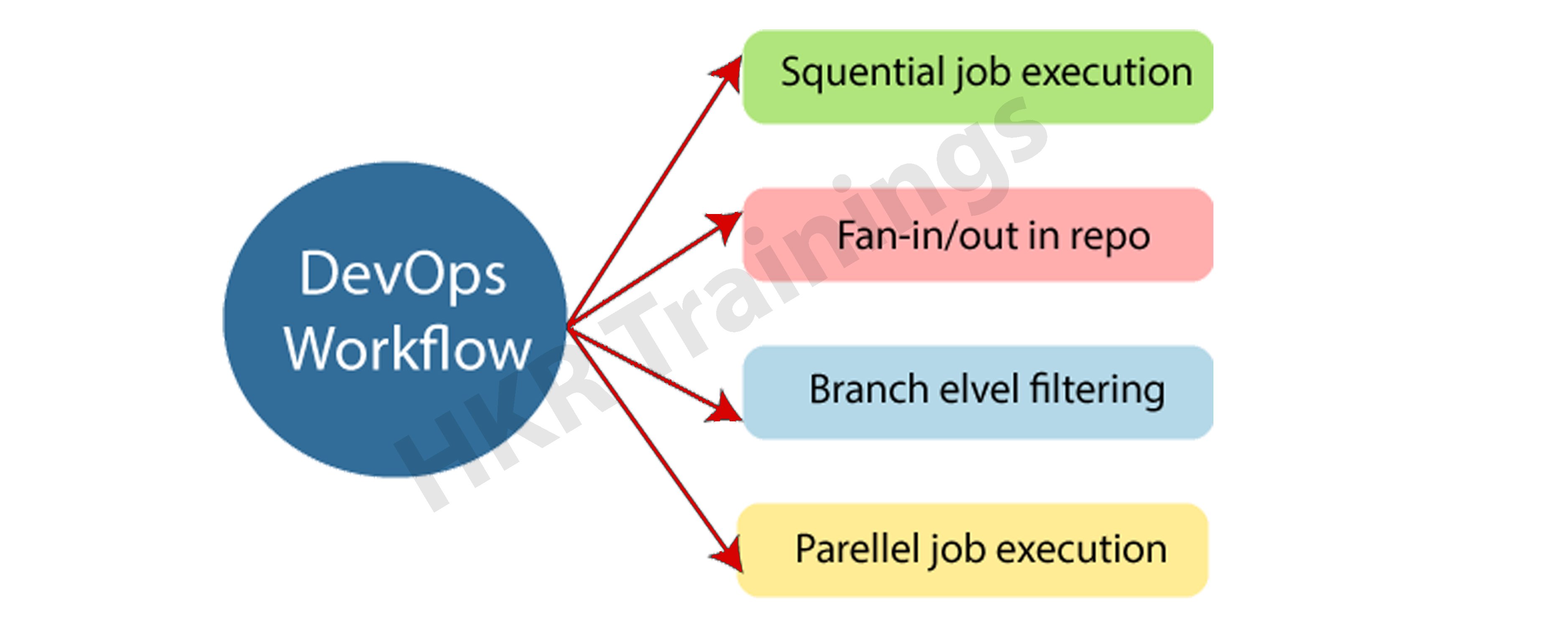
A DevOps workflow is a visual representation of the order wherein input is supplied. It also specifies which action is carried out and what output is created for an operations procedure. The capability to segregate and organize the tasks that are most frequently requested by users is provided by DevOps workflow. It also allows them to replicate their ideal approach in configuration jobs. Agility and automation are at the heart of the DevOps process flow.
DevOps Principles
- Continuous delivery, mechanization, and a quick response to feedback are the fundamental principles of DevOps.
- End-to-end responsibility: The DevOps team is responsible for providing performance support till the product is retired. It improves the responsibility and quality of the engineered products.
- Continuous Improvement: The DevOps culture places a strong emphasis on continuous improvement to reduce waste. It keeps increasing the number of items or services available.
- Automate Everything: The DevOps method relies heavily on automation. This applies to both software development and the overall infrastructure landscape.
- Customer-Centric Action: The DevOps team must be customer-centric, which means they must invest in new products and services regularly.
- Everything must be monitored and tested: The DevOps team must follow strict monitoring and testing protocols.

Cloud Computing Essentials Training
- Master Your Craft
- Lifetime LMS & Faculty Access
- 24/7 online expert support
- Real-world & Project Based Learning
DevOps Workflow Process
Collaboration and developing methods to streamline components of the lifecycle are fundamental to the DevOps process flow. Organizations will have to collaborate at each stage of the process to determine whether changes could be made or where mechanization certainly makes sense. By continuous development, integration, tests, monitoring and evaluation, delivery, and deployment, each phase of the DevOps lifecycle concentrates on sealing the gap between operations and development and driving production.
Let’s go through each process in detail.
Continuous development
The iterative process of producing software to be provided to clients is referred to as continuous development. Integration, continuous delivery, continuous testing, and continuous deployment are all part of the process. Businesses can accomplish quicker deployment of new services or products that are of better quality and much lesser risk by executing a continuous development strategy as well as its accompanying sub-strategies, without running into substantial bandwidth restrictions.
Want to know more about GOCD,visit here GOCD Tutorial !
Continuous integration
Continuous integration (CI) is indeed a software development technique that is frequently used in the DevOps process flow. Developers integrate the changes to the system into the shared repository regularly, and the updates are tested automatically. Continuous integration ensures that developers always have access to the most up-to-date and approved code. CI helps avoid costly development delays by allowing several developers to confidently operate on the very same source code, rather than waiting until release day to integrate various pieces of code all at once. This procedure is an important part of the DevOps process flow and strives to combine speed, agility, and security.
Continuous Integration is the core of the DevOps Lifecycle because every individual from a group incorporates their work. Every single incorporation is confirmed by a computerized work to recognize the reconciliation that happens as quickly as time permits. You need to remember that you are required to pick a dependable technique to guarantee that bugs are discovered significantly earlier in the CI/CD pipeline. Some of the continuous integration servers are given below.

Continuous Testing
Continuous testing is a validation technique that helps developers to confirm that their code works as expected in a real-world setting. Testing can reveal flaws and specific areas of the item that have to be fixed or improved, and these issues could be sent back to the production stage for further development.
Continuous Monitoring
Your organization should have procedures and practices for continuous monitoring and feedback of the equipment and solutions throughout the development pipeline. To give constant input, the entirety of the review process must be automated. This method enables IT operations to detect problems and alert programmers in real-time. Continuous feedback promotes increased security and system reliability, as well as quick reactions when problems develop.
Continuous Delivery
Continuous delivery is a software improvement practice where code alters are consequently ready for delivery to production. A stronghold of current application advancement, continuous delivery develops by sending all code alters to a testing climate or potentially a creation climate after the construct stage. When appropriately executed, engineers will have a deployed prepared form that has gone through a state-sanctioned test method.
Continuous delivery allows engineers to computerize testing past unit tests so they could check app refreshes across numerous measurements before sending them to clients. These methods may incorporate load testing, UI testing, reconciliation testing, API reliability quality testing, and so forth. This aids engineers is completely approving updates and preemptively finding issues. By utilizing the cloud, it is simple and practical to robotize the production and repetition of various conditions for testing that was already hard to perform on-premises.

Continuous Deployment
Continuous Deployment (CD) is a software discharge method that utilizes robotized testing to approve if alterations to a codebase are right and stable for autonomous deployment to a creation climate. The software release cycle has advanced over the long run. The method of moving code starts with one machine then onto the next and checking if it is utilized to be an error inclined and asset substantial cycle. Presently, apparatuses can mechanize this whole deployment measure, which permits designing associations to zero in on center business requirements rather than foundation overhead.
Continuous Deployment is a platform from Continuous Delivery in which each adjustment in the source code is conveyed to production consequently, without unequivocal endorsement from a producer. A designer’s employment finishes by exploring a draw demand from a colleague and combining it to the expert branch. CI/CD assistance begins from that point by operating all tests and conveying the code to creation while maintaining the group educated about the result of each significant event. Continuous deployment requires an exceptionally evolved culture of checking and having the ability to recuperate rapidly.
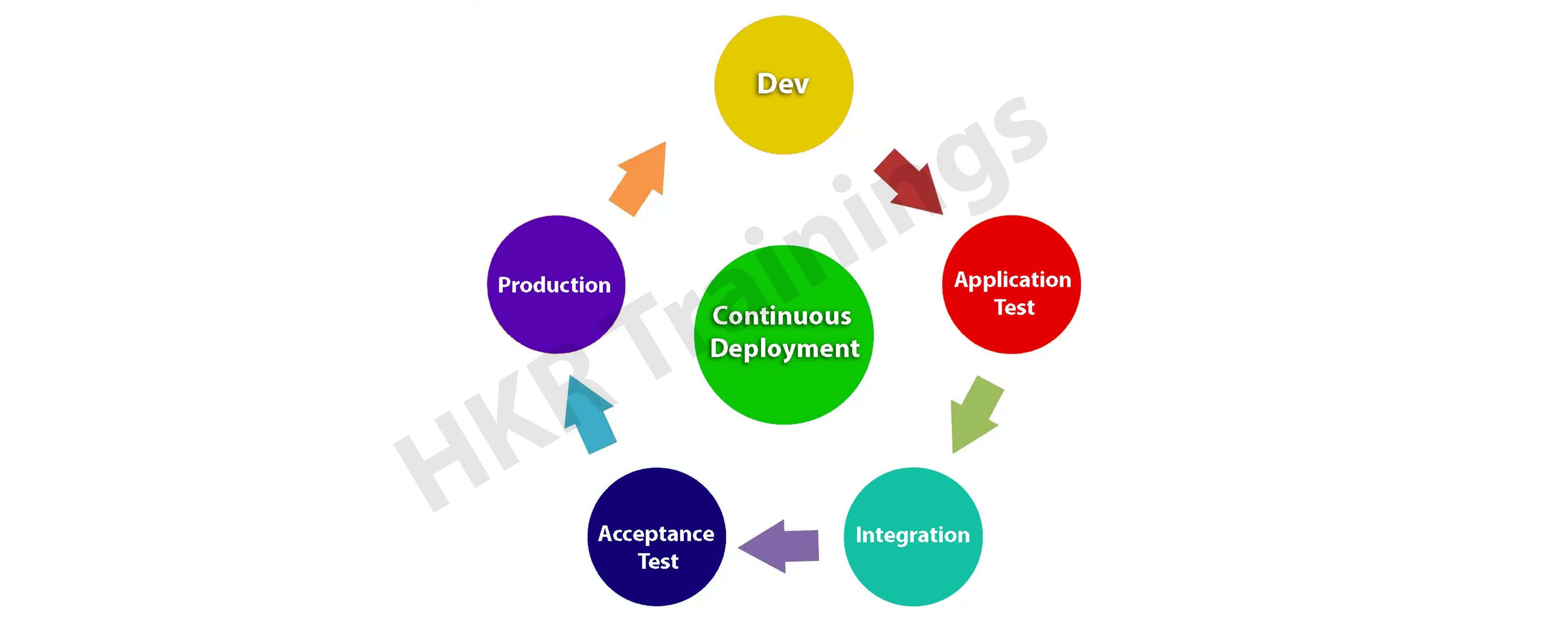
Every validated modification is automatically delivered to users via a continuous deployment procedure. This method eliminates the requirement for set release dates and shortens the feedback loop. Developers can gather user feedback faster and address issues with greater agility and accuracy with smaller, more frequent releases.
To gain in-depth knowledge with practical experience in Devops, Then explore hkr’s Devops Training in Hyderabad !
Continuous deployment is an excellent decision for a DevOps team, and should only be implemented once the DevOps method has been refined. Organizations need a robust and dependable automated testing environment for continuous deployment to perform properly. Beginning using CI and CD would assist you to get if you haven’t already.

Subscribe to our YouTube channel to get new updates..!
Best practices for developing a DevOps workflow
- It must be simple and obvious again for the DevOps process flow to work. That’s the simplest way of putting it. In reality, this means the workflows ought to be smaller than huge, with a clear grasp of how each phase relates to the next. The simpler your process is, the simpler it will be to follow.
- Consistent check-ins throughout the process can also help identify problems and areas where clarification is required. Recognizing metrics as well as other performance metrics can also assist you in tracking how the team has progressed over time. Tracking and optimizing can be aided by doing so, both in the short and long term. Finally, support and promote keeping track of work and objectives how they’re progressing.
- Also, look at each phase of the process separately and collectively and see how it fits together or whether groups have quite enough data to do work fast. The layout of incident reports, for example, can enable the workflow understandable and adjusted. During the automated testing phase, a simple success or ‘fail’ won’t inform developers much. Before anything can be corrected, some detective work will be required to discover what went wrong. Making the outcomes more clear and providing detailed data, on the other hand, aids developers in quickly identifying the problem and resolving it.
- It’s also a good way to create everything as clear as feasible so that everyone on the team knows what they’re supposed to do and what their function is. And it is always preferable to over-explain a position than to presume that everyone will understand it.
Benefits of DevOps
- While it isn’t a panacea, DevOps can alleviate many of the problems that plague traditional IT organizations. Its emphasis on cooperation, automation, and agility has several advantages, including:
- Time to market is reduced.
- A higher return on investment
- A higher level of user/customer satisfaction
- Increased productivity
- Collaboration has improved.
- Issues should be identified and corrected as soon as possible.
One of the numerous advantages of DevOps is the much reduction in risk of misinterpretation or misalignment because teams work together effortlessly, backed by both method and culture. Increased efficiency and, as a result, greater quality goods arise from clear communication.
Agile approaches, like continuous integration and deployment, when accompanied by automation testing and regular feedback, help to speed up the development process while also ensuring that bugs and other issues are identified and addressed early on.
Overall, it’s no surprise that so many businesses are hurrying to embrace this approach to take full advantage of DevOps. A DevOps methodology, when properly applied, leads to a better product, happier consumers, and better bottom lines.
Top 30 frequently asked Devops Interview Questions !
Putting DevOps into practice in your company
The effort of implementing a DevOps strategy in the firm can appear onerous if you haven’t done so already. Keep in mind that this isn’t just a process change; it’s also a cultural change.
Consider introducing DevOps in stages if you want to achieve success. Based on where your company is now, you might want to take an agile approach to DevOps adoption. The following is an example of a gradual implementation sequence:
- Create a flexible development methodology.
- Take advantage of cloud computing.
- Adapt your operations to a continuous integration and continuous delivery (CI/CD) workflow.
- Automate the installation of your program.
- Software testing can be automated.
- Continuous deployment should be implemented.
Please remember that DevOps automation necessitates a transformation in both infrastructure and tooling. You risk having holes in the DevOps process flow if you don’t have the right infrastructure and technologies to support your processes. Every step of the design phase must be as mechanized and agile as feasible to build a true DevOps environment.
Examine how graphics can assist you in mapping out existing DevOps processes and gaining a better understanding including everything from who’s working on what to timetables and process flows. Visuals can help streamline the implementation process by ensuring that everyone is on the same page from the beginning.
Cloud Computing Essentials Training
Weekday / Weekend Batches
Conclusion
Understanding the DevOps process and how firms may best embrace this new strategy as the future of IT administration shifts to DevOps. The goal is to increase communication and collaboration between IT development and operations, establish more seamless processes, and match vision and strategy for quicker and more accurate delivery. Only how much you can evaluate can be improved, and you can just assess whatever you know. That’s why it’s essential to comprehend DevOps workflow best practices and what they signify for your company.
Related Articles:

Stephan is the sports journalist for the Maple Grove Report.




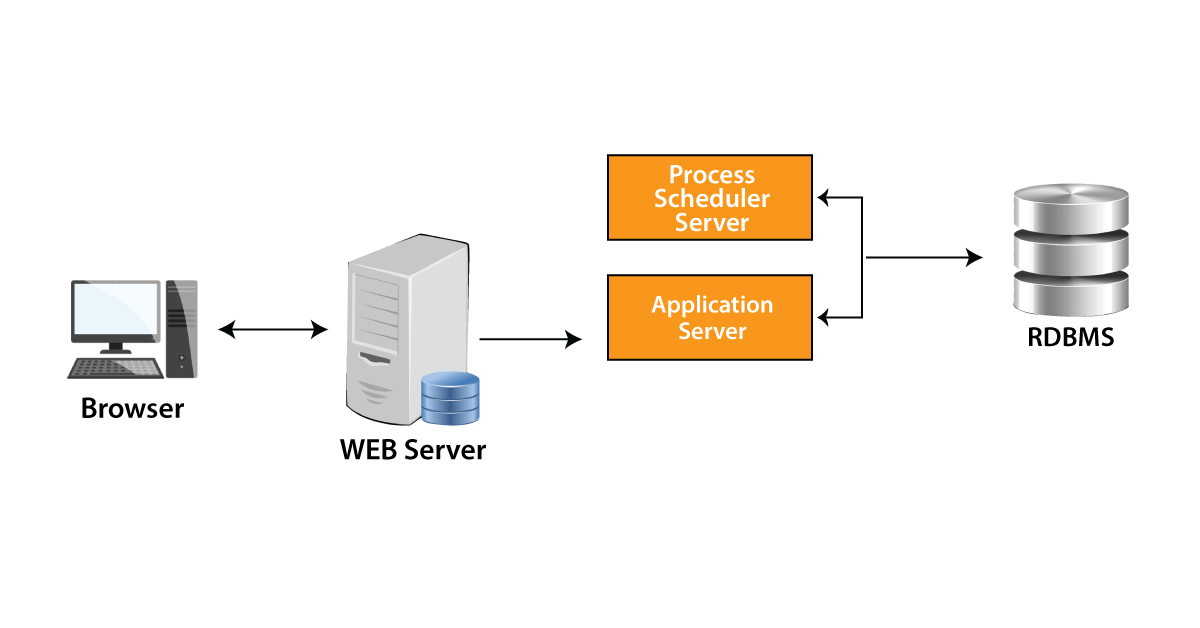

 The requests are sent by the web browser to the web server. The web server will pass the request to the application server, which will generate the SQL to be executed in the database.