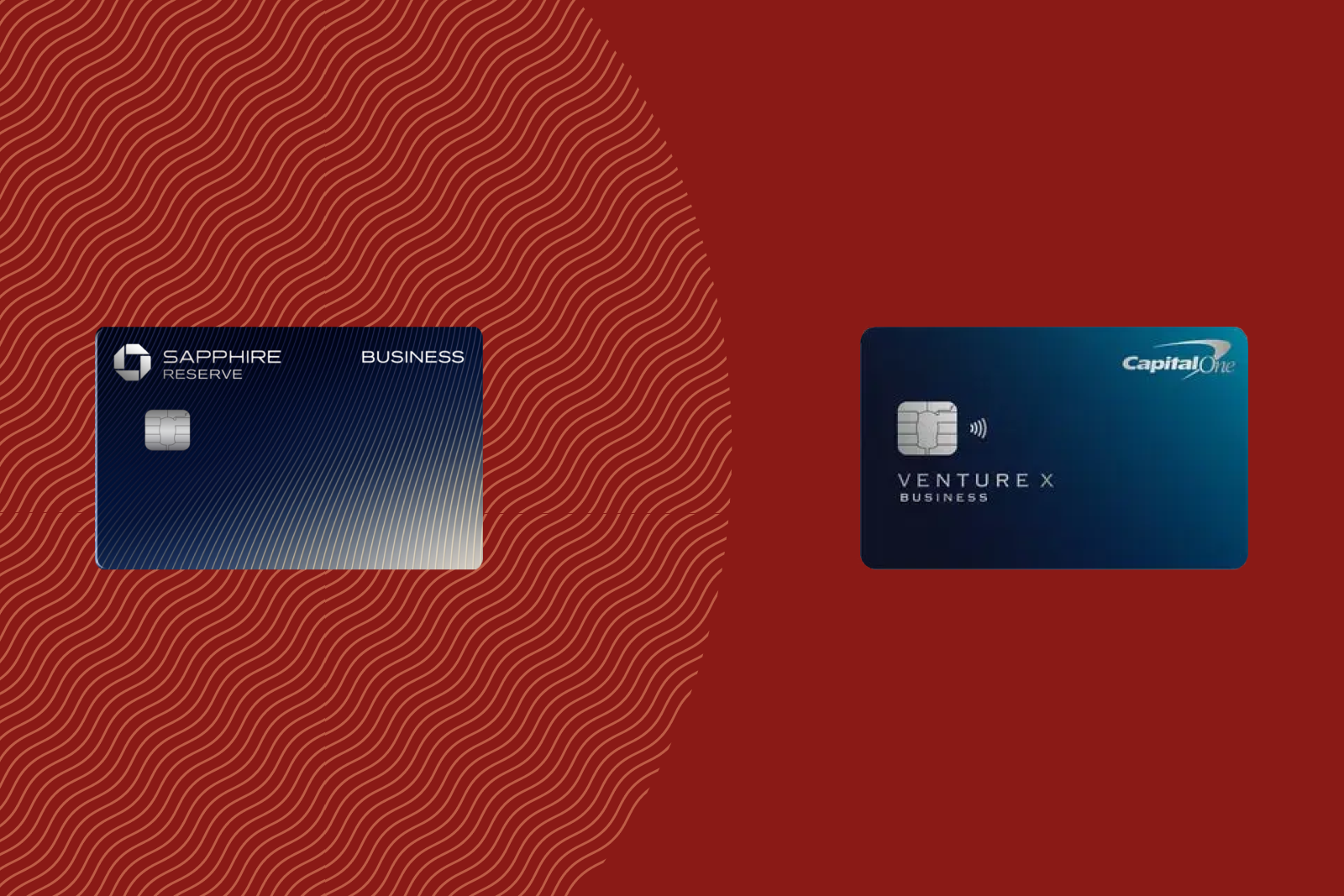

It’s worth reserving a spot in your wallet for a premium business card (or two).
The right option can provide lounge access, a great welcome bonus, useful statement credits and strong protections. The wrong choice, however, can leave your bottom line needlessly burdened by an annual fee you aren’t getting any value out of.
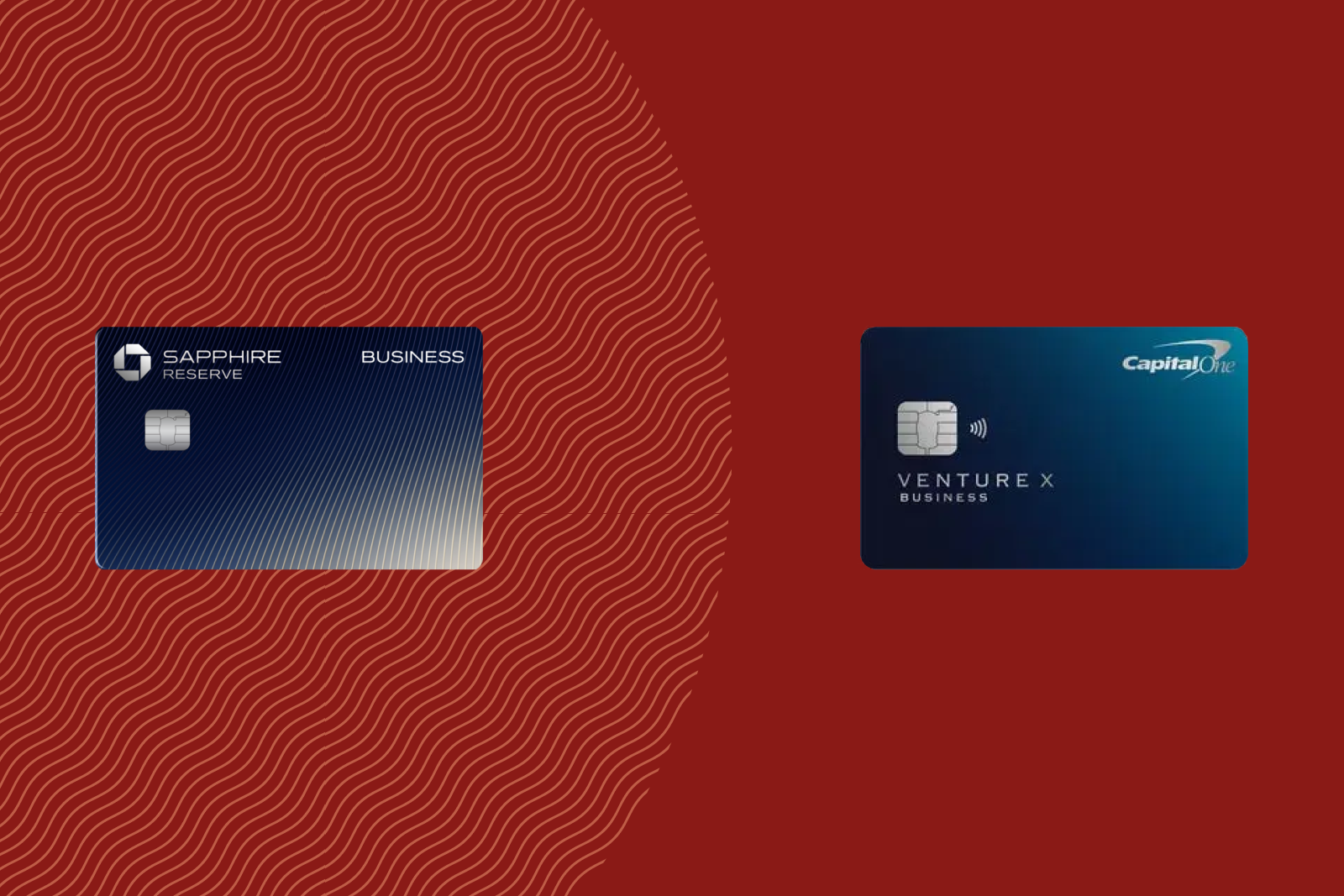
With the $795 Chase Sapphire Reserve for Business℠ (see rates and fees) being one of the most expensive business cards from any of the major issuers, it’s reasonable to wonder if the much-cheaper $395 Capital One Venture X Business is a better fit for your wallet.
Both of these cards provide statement credits, lounge access and solid earning rates to help entice prospective cardholders and keep existing ones.
The Venture X Business offers a greater degree of simplicity with its benefits, while the Sapphire for Business is a great fit for business owners who like fine-tuning their finances.
Let’s get down to the nitty-gritty of these cards so you can decide which is best for you.
Capital One Venture X Business vs. Chase Sapphire Reserve for Business comparison
|
Card |
Capital One Venture X Business |
Chase Sapphire Reserve for Business |
|---|---|---|
|
$395 |
$795 |
|
|
|
|
|
Earn 150,000 bonus miles after spending $30,000 on purchases within the first three months from account opening. |
Earn 150,000 bonus points after spending $20,000 on purchases within the first three months from account opening. |
|
|
|
|
|
|
Capital One Venture X Business vs. Chase Sapphire Reserve for Business welcome offer
With the Venture X Business, new cardholders can earn 150,000 bonus miles after spending $30,000 on purchases within the first three months from account opening.
According to TPG’s April 2026 valuations, that’s $2,775 in value when those miles are transferred to partners.
The Sapphire Reserve for Business offers new cardholders 150,000 bonus points after spending $20,000 on purchases within the first three months from account opening.

Reward your inbox with the TPG Daily newsletter
Join over 700,000 readers for breaking news, in-depth guides and exclusive deals from TPG’s experts
According to TPG’s April 2026 valuations, 150,000 Chase Ultimate Rewards points are worth $3,075.
Note that Chase’s eligibility requirements for the welcome bonuses on its consumer Sapphire cards don’t apply to the Sapphire Reserve for Business. So, even if you already have one or both of the consumer Sapphire cards, you can earn the welcome bonus on this card.
Winner: Sapphire Reserve for Business. It earns the same amount of points with a lower spending requirement.
Capital One Venture X Business vs. Chase Sapphire Reserve for Business benefits
Here’s where things really start to get interesting between these two cards.
With its $395 annual fee, the Venture X Business offers fewer benefits than the $795 annual fee Sapphire Reserve for Business. However, those benefits are simpler to track and suited to a wider range of businesses.

Statement credits
The Venture X Business only offers two notable statement credits: A Global Entry/TSA PreCheck credit and an annual $300 Capital One Business Travel credit.
The Sapphire Reserve for Business asks cardholders to break out the spreadsheet to keep track of all its credits:
- $300 travel credit: This credit is identical to the Chase Sapphire Reserve®‘s (see rates and fees) beloved travel credit. It can be used for a wide range of purchases, not just those booked through Chase Travel.
- $500 annual The Edit credit (minimum two-night stay required, up to two $250 statement credits): The Edit is Chase’s luxury hotel collection. In addition to this statement credit, cardholders will get a $100 on-property credit, early check-in, late checkout and more.
- One up to $250 statement credit for eligible Chase Travel hotel bookings: Through Dec. 31 at eligible properties
- $120 statement credit for Global Entry, TSA PreCheck or Nexus: I always advise going for Global Entry since it includes TSA PreCheck, so I don’t knock the Venture X Business here for not covering Nexus with its credit.
- Complimentary DoorDash DashPass membership and up to $25 each month in DoorDash promos (activate by Dec. 31, 2027)
- Up to $200 annual Google Workspace credit (ends Dec. 31, 2027)
- Up to $400 ZipRecruiter credit (up to $200 biannually; ends Dec. 31, 2027)
- Up to $120 annual Lyft credit (up to $10 monthly; ends Sept. 30, 2027)
- Up to $100 Giftcards.com credit (up to $50 biannually; ends Oct. 31, 2028)
If your business uses these merchants already, then the Sapphire Reserve for Business is likely a better fit for you than the Venture X Business.
However, businesses that don’t gravitate toward these merchants will struggle to get positive value out of the Sapphire Reserve for Business’s annual fee.
While the Reserve for Business’s $300 travel credit is much more flexible than the Venture X Business’s $300 Capital One Business Travel credit, the Venture X Business’s credit does a lot more to knock down its annual fee versus the Reserve for Business’s.
Speaking of knocking down annual fees, the Reserve for Business’s perks total $3,000 in value. That means businesses that can take advantage of them will recoup almost four times the value back from their card’s annual fee each year.
Related: Monthly checklist: Credit card perks and benefits you should be using this month
Lounge access
Lounge access is a coveted benefit for premium cardholders.
The Reserve for Business and the Venture X Business both satisfy here, with each card providing a Priority Pass Select membership and access to its issuer’s network of lounges.
Capital One’s lounge network is smaller than Chase’s lounges at the moment, but your preference will come down to which airports you fly through most often.
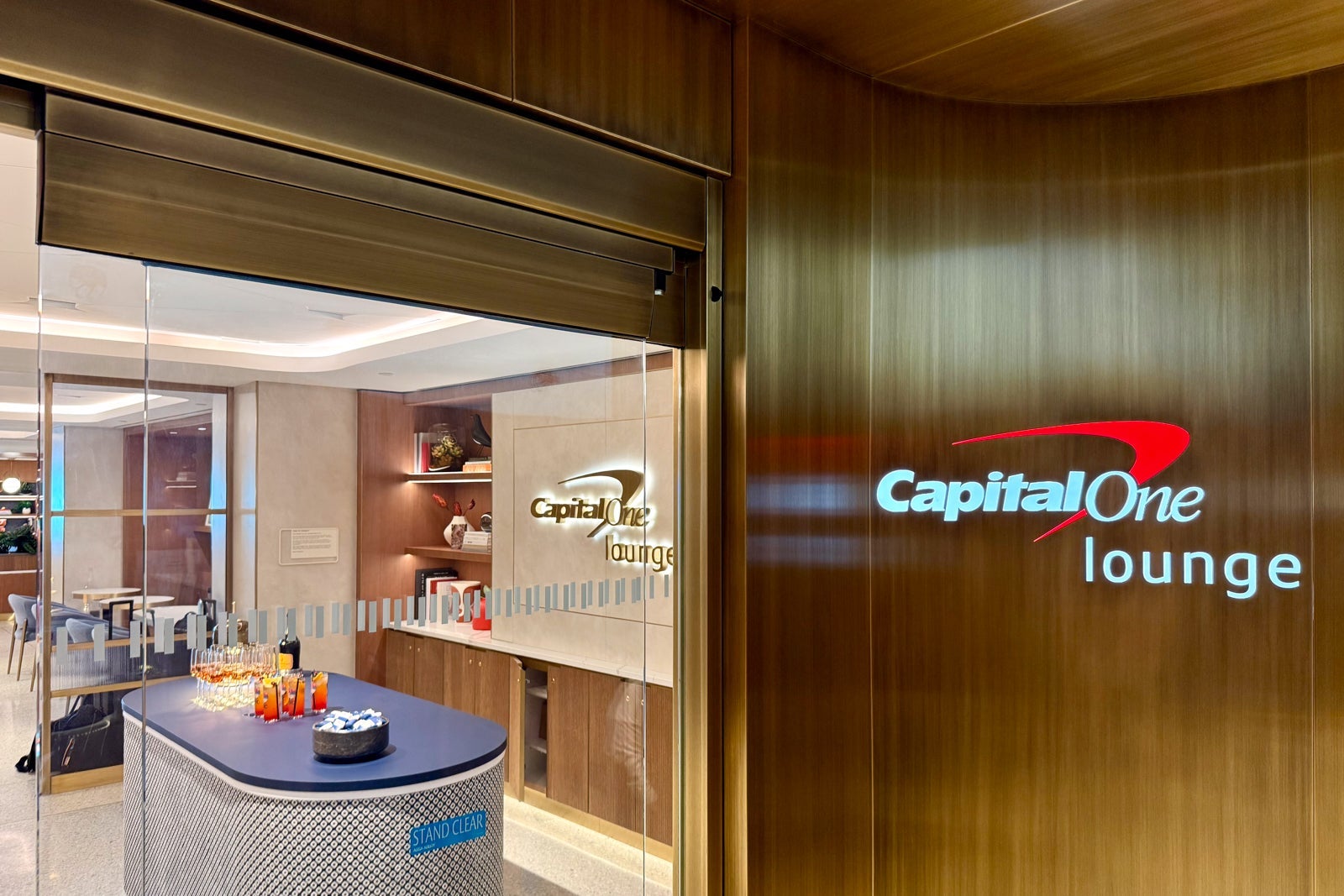
You can bring two guests into Sapphire lounges for free with your Reserve for Business, but the Venture X Business doesn’t offer this perk unless you spend $75,000 in a calendar year.
Other benefits
The Venture X Business doesn’t provide hotel status, while the Sapphire Reserve for Business grants cardholders complimentary IHG One Rewards Platinum Elite status (through Dec. 31, 2027).
If you spend at least $120,000 on your card in a year, you’ll be upgraded to IHG One Rewards Diamond Elite status.
The same $120,000 in spending will also get you a $500 The Shops at Chase credit, a $500 credit for Southwest Airlines flights booked through Chase Travel and Southwest Rapid Rewards A-List status.

Even though Venture X Business cardholders don’t receive any special benefits for spending a certain amount, I don’t consider this a win for the Reserve for Business. These extra perks are lacking for the exorbitant spending requirement.
One of my favorite benefits of the Venture X Business is something the Reserve for Business can’t match: a 10,000-mile anniversary bonus. You’ll receive this regardless of how much you spent the previous year. According to TPG’s April 2026 valuations, those 10,000 miles are worth $185.
Both cards are fairly aligned in terms of protection. They both offer trip delay insurance, lost baggage insurance, purchase protection, cellphone protection and extended warranty.
The Sapphire Reserve for Business offers a few extra travel protections, such as travel accident insurance and emergency medical and dental coverage, plus return protection.
The Venture X Business offers ride-hailing protection, a rarity on premium cards.
Winner: Tie. Using the Venture X Business’s benefits requires less work, but the Sapphire Reserve for Business has more extensive travel protection and many more statement credits.
Related: The 5 easiest travel credits to redeem
Earning rewards with the Capital One Venture X Business vs. Chase Sapphire Reserve for Business
Both cards hit the same categories, but the Sapphire Reserve for Business offers more earning categories beyond what the Venture X Business has.
With the Venture X Business, you’ll earn:
- 10 miles per dollar spent on hotels and rental cars booked through Capital One Business Travel
- 5 miles per dollar spent on flights and vacatio rentals booked through Capital One Business Travel
- 2 miles per dollar spent on all other purchases

On the other side, the Reserve for Business earns:
- 8 points per dollar spent on all Chase Travel purchases
- 5 points per dollar spent on Lyft (through Sept. 30, 2027)
- 4 points per dollar spent on flights and hotels booked directly
- 3 points per dollar spent on social media and search engine advertising
- 1 point per dollar spent on all other purchases
Neither of these cards earns significant rewards per dollar spent on office supplies, internet, cable or phone services.
I really appreciate the Reserve for Business’s no-limit spending cap for its advertising category, since this is a common barrier issuers (including Chase) often put on their business cards.
For nonbonus spending, the Venture X Business is the clear winner with 2 miles per dollar spent.
If you don’t spend a lot in the Reserve for Business’s categories, the Venture X Business can still earn you a heap of rewards. That said, most businesses will get a lot of use out of the Reserve for Business’s roster of categories.
Winner: Sapphire Reserve for Business. It offers more spending categories, including a rare uncapped advertising category.
Related: Maximizing credit cards to become points-rich without spending a ton
Redeeming rewards with the Venture X Business vs. Chase Sapphire Reserve for Business
Here at TPG, we preach about prioritizing transfer partners over any other redemption method. That rings true here as well.
If transfer partners aren’t your style, you have other options. With the Venture X Business, you can redeem your miles for:
- Booking travel through Capital One Business Travel
- Covering recent travel purchases
- Gift cards
- Amazon and PayPal purchases
- A statement credit or check

Meanwhile, Sapphire Reserve for Business cardholders can redeem their points for the following:
- Chase Travel bookings
- Gift cards
- Amazon purchases
- Apple purchases
- Statement credits
Generally, these options will yield a lower redemption value than TPG’s target value for these rewards currencies.
The only exception is when you make eligible bookings through Chase Travel using Chase’s Points Boost feature.
With the Sapphire Reserve for Business, your points could be worth as much as 2 cents per point, depending on the booking you’re making. That’s close to TPG’s April 2026 valuation of Chase points at 2.05 cents per point.
Winner: Sapphire Reserve for Business. Points Boost offers the chance to get more value out of your rewards than any other redemption option, aside from transferring your rewards to partners.
Transferring rewards with the Capital One Venture X Business vs. Chase Sapphire Reserve for Business
The transfer partner battle mainly comes down to which issuer offers the partners you prefer to redeem with.
For example, if you primarily fly domestically, you’ll want to look for an issuer that partners with the most domestic airlines.
Capital One currently offers the following transfer partners:

Of these transfer partners, Chase lacks most of them. Chase and Capital One only share Air Canada Aeroplan, Air France-KLM Flying Blue, British Airways Club, JetBlue TrueBlue, Singapore KrisFlyer and Wyndham Rewards between them.
In exchange for what they don’t have, Chase offers:
As a major United Airlines and Hyatt fan, I’m partial to Chase’s transfer partner roster. But this choice is highly subjective, so make sure to carefully consider which partners your business can easily use.
We generally recommend transferring your points or miles to partners to get the most value out of your redemption.
TPG credit cards writer Augusta Stone likes to redeem Capital One miles for short-haul domestic flights, such as when she used 15,000 Capital One miles through Air France-KLM Flying Blue to book two one-way Delta Air Lines flights between Greenville-Spartanburg International Airport (GSP) and Detroit Metropolitan Wayne County Airport (DTW).
TPG managing editor for credit cards Giselle Gomez scored seven nights at the Lindner Hotel Vienna Am Belvedere during peak summer (June) by transferring 56,000 Ultimate Rewards points to Hyatt. This would have otherwise cost her close to $1,300.
Winner: Tie. Both cards offer transfer partners that the other doesn’t, so the ultimate choice comes down to personal preference.
Should I get the Capital One Venture X Business or Chase Sapphire Reserve for Business?
Although the Sapphire Reserve for Business wins in most of these categories, I recommend going with the Venture X Business if you don’t regularly spend with the merchants covered by the Reserve for Business’s credits.
If you spend heavily on advertising or with the merchants covered by the Reserve for Business’s benefits, that card is the right choice for you.
Bottom line
The Venture X Business and the Sapphire Reserve for Business are two great options for businesses looking for a premium card.
Each has its own pros and cons, so it’s important to carefully weigh them before deciding.
If your business has the budget for two annual fees, it may even be worth opening both of these cards. I always advocate for dipping into multiple rewards ecosystems, so you have access to the widest range of transfer partners.
Regardless of the path you choose, these two cards can unlock incredible travel experiences and business savings for you and your employees.
To learn more, check out our full reviews of the Venture X Business and the Sapphire Reserve for Business.
Learn more: Capital One Venture X Business
Apply here: Chase Sapphire Reserve for Business
For Capital One products listed on this page, some of the benefits may be provided by Visa® or Mastercard® and may vary by product. See the respective Guide to Benefits for details, as terms and exclusions apply.

Stacie Harris is a local resident and reporter of the Maple Grove area. Stacie reports on medicine and science for the Maple Grove Report.