Moorhead gets $10M to finish flood mitigation projects


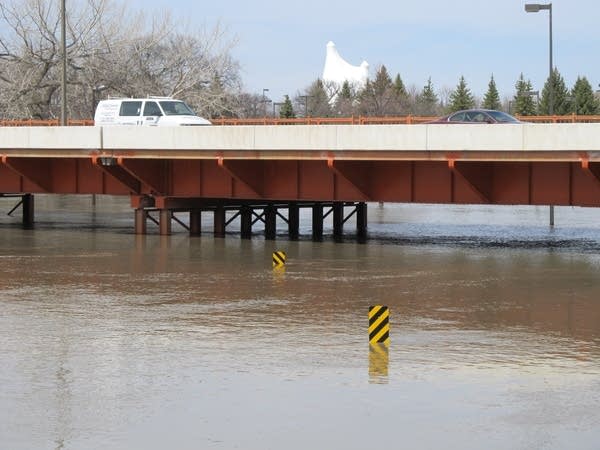
Flooded Red River

The Fargo-Moorhead area has had many major flooding events and in 2009, an especially devastating flood prompted local city officials to jumpstart infrastructure improvements.

Now, 17 years later, the Minnesota Legislature awarded $10 million to the City of Moorhead for local flood mitigation infrastructure improvements.

The Metro Flood Diversion Authority, which oversees the construction of the Fargo-Moorhead Area Diversion, a $3.2 billion project meant to divert excess water around the metro area during intense flooding events, also agreed to match the $10 million award.

Lisa Bode, governmental affairs director, said at a recent city council meeting that this means the Moorhead has finally secured enough money to complete the city’s ongoing construction and upgrades to its flood mitigation infrastructure.

“For those of you and our staff who have been around for the floods of 1997, 2009, 2010 and 2011, and others, this is cause for major celebration,” Bode said. “For those who weren’t, we have lots of stories to share.”

Moorhead builds a secondary levee
A levee in Fargo, N.D. in 2009.
Scott Olson | Getty Images

Moorhead’s vulnerabilities to flooding

The 2009 flood served as a lesson for engineering director Bob Zimmerman and his team. It helped them understand Moorhead’s vulnerabilities and where the city needed to invest to protect the community.

As soon as the engineering team knew there was a risk of flooding, they went to the houses on the riverfront and asked the residents to place sandbags facing the river. In about a week, 2.5 million sandbags were placed in a line to form a wall against the river.

“There were huge numbers of volunteers that came from all over, outside of the region, to help make those sandbags, and to help place those sandbags,” Zimmerman said.

Volunteers build a sandbag levee
Workers from the RDO Equipment company help to build a sandbag levee in the Harwood Groves neighborhood along the Red River in 2009.
Scott Olson | Getty Images

The makeshift levees were only about six inches above where the river crested, Zimmerman said, but they still somehow held the water back. That experience taught Zimmerman which areas along the riverfront needed levees to protect the city from flooding.

The city later bought many of the properties across the riverfront that the owners voluntarily sold.

During the flood, Zimmerman also learned the city’s stormwater system needed an upgrade. The system was designed to pump excess water into the river. But when the river’s water levels rose to over 40 feet, the water ended up flowing back through the pipes and into the city’s streets.

“[The water] threatened properties blocks away from the riverfront,” Zimmerman said. “We didn't have gates or controls on those storm sewer pipes.”

Flooding at Oak Grove school in Fargo
A man clears a pump intake, removing flood water from the campus of Oak Grove Lutheran School after a levee break flooded the area.
Scott Olson | Getty Images 2009

The city has since built those controls, but they were missing upgrades to the sewer pump stations that could push water through the pipes away from the city in case of another flood.

“It's incredible,” Zimmerman said. “ People experienced what we call flood fatigue, and to keep the momentum going when [flooding] is not front page news is a challenge, but we've made it through that challenge.”

Zimmerman said the upgrades could be done by the end of next year.

Flood prediction challenges

One factor that makes it hard to predict floods in the region is melting snow, which is a major cause of flooding.

It’s hard to know how much snow has accumulated and how fast it melts. That makes it difficult to predict when floods may happen, according to Zac McEachran, a research hydrologist at the University of Minnesota Climate Adaptation Partnership

“It's really hard to represent all of these little factors in a computer model,” McEachran said.

Snow-covered trees sit in floodwaters in Moorhead
Snow-covered pine trees sit in flood water near Moorhead.
Scott Olson | Getty Images 2009

The snow and ice that accumulate in the winter often melt rapidly in spring as the southern areas of the valley warm up before the north.

The river also flows from south to north, which means that all the snowmelt at the bottom of the river flows upward, putting northern cities at higher risk of flooding.

The Red River Valley is flat as well. So, if the river’s water levels rise by even just a foot, a whole mile of land can get covered in water, according to McEachran.

McEachran is currently working on a study about the potential impacts of projected climate warming on river flooding.

A home is surrounded by water in Oakport Township
A home is surrounded by water in Oakport Township near Moorhead.
Scott Olson | Getty Images 2009

While the research is still underway, he said there is reason to expect that extreme rainfall may become a bigger factor in flooding than snowmelt has been in Minnesota in the past as the climate continues to change.

“There is a certain baseline risk of flooding in the Red River Valley; we have indications that that's going to continue. We have indications it might get worse,” McEachran said. “So, in general, investing in adaptation, investing in ways to manage our water, and in ways to better anticipate when these extreme events may strike, I think, is a good call.”




Source link

Leave a Reply

Subscribe to Our Newsletter

Get our latest articles delivered straight to your inbox. No spam, we promise.

Recent Reviews


If you do not owe any tax for a year and you are certain of it, can you just file an income tax return that reports all zeros for income and lists the amount you paid to the IRS that you want refunded? I’ll refer to this as a “zero income-tax return.”

This is a valid question, as many taxpayers do not owe or have to pay income taxes. Our income tax burden is primarily paid by those in the middle class and upper class. The majority of taxpayers may still file tax returns to obtain refunds of amounts they paid in to the IRS by wage withholdings or even refundable tax credits, such as the child tax credits. In these cases, it might make sense to file a zero income-tax return and just list the amount of tax paid that is to be refunded. This would be consistent with the push for the IRS to simplify the tax reporting process for taxpayers. This would even make the Trump-era postcard tax return idea possible for most Americans. And some states, such as Texas with its franchise tax, have a similar concept. Texas calls it a no-tax due form.

But does Federal law allow for this? Will the IRS accept a zero-income tax return? The recent Varela v. Commissioner, T.C. Memo. 2024-85, provides an opportunity to consider this question and explore the potential consequences of filing a zero-income tax return when no tax is due.

Facts & Procedural History

The taxpayer filed a Form 1040EZ, Income Tax Return for Single and Joint Filers With No Dependents, for the 2017 tax year. The return reported zero wages and zero taxable income. It listed the standard deduction and sought a refund of $1,373, comprising federal income tax, Social Security tax, and Medicare tax withholdings that had been paid to the IRS.

Attached to the Form 1040EZ were four Forms 4852, Substitute for Form W-2, each reporting zero wages or income.

Third parties had filed information reporting forms with the IRS indicating that the taxpayer had received $11,311 in wages and $1,436 in cancellation of indebtedness income. These amounts appear to be about the same amount as the allowable standard deduction and personal exemption for 2017.

The IRS’s automated underreported program no doubt detected the discrepancy and sent the taxpayer a CP2000 notice.

The matter ended up in the U.S. Tax Court and the parties settled the case agreeing that no tax was due. The IRS assessed a $5,000 penalty under Section 6702(a) for filing a frivolous tax return for the zero income-tax return the taxpayer had filed. The taxpayer disputed the penalty, and the dispute ended up back before the U.S. Tax Court.

Duty to File Returns & IRS Processing

To understand whether one can simply file a zero income-tax return, we have to first consider the rules that require tax returns to be filed and that require the IRS to process them.

Section 6011 generally requires any person liable for any tax to make a return according to the forms and regulations prescribed by the Secretary of the Treasury. There are exceptions and other forms can be used, even though the IRS does not like it. Section 6001 then imposes an obligation for taxpayers to make returns and keep and provide books and records to the IRS on request.

Complementing this duty is the IRS’s obligation to process tax returns. Section 6201(a) requires the IRS to assess all taxes imposed by the tax code. This includes the duty to process and record the tax returns filed by taxpayers. The IRS is not, however, required to process a document that is filed that is not a tax return.

What Counts as a Tax Return?

The question of what constitutes a tax return has been the subject of numerous court cases. Beard v. Commissioner, 82 T.C. 766 (1984), aff’d, 793 F.2d 139 (6th Cir. 1986) is the leading case for this.

In Beard, the tax court established a four-part test for determining whether a document qualifies as a valid return. Under the “Beard test” a document is a tax return if:

  1. The document purports to be a return
  2. It is executed under penalties of perjury
  3. It contains sufficient data to allow calculation of tax
  4. It represents an honest and reasonable attempt to satisfy the requirements of the tax law

This “Beard test” has been widely adopted by federal courts.

Under the Beard test, a tax return that reports zero income may fail the third and fourth prongs of this test, especially if the IRS has information indicating that the taxpayer had taxable income.

Counterintuitively, it is often the taxpayer who is asserting that a document that was filed is not a tax return. This can be an “out” for taxpayers who file frivolous tax returns when the IRS imposes frivolous tax return penalties or even a fraudulent tax return, for example. The IRS asserted the frivolous return penalty in the present case. Reading the court opinion, it appears that the taxpayer did not raise the no-return argument as a defense.

The Frivolous Return Penalty

As this case shows, the IRS may be inclined to impose a frivolous return penalty if a taxpayer files a zero income-tax return. Section 6702(a) authorizes the IRS to impose this penalty and explains that the penalty is $5,000 for each frivolous tax return that is filed.

For this penalty to apply, the tax return has to be “frivolous.” Naturally, taxpayers and the IRS often do not agree as to whether documents are “frivolous.” That was the dispute in this case.

The courts have generally said that a tax return is considered “frivolous” if:

  1. It does not contain information on which the substantial correctness of the self-assessment may be judged, or contains information that on its face indicates the self-assessment is substantially incorrect; and
  2. The position taken is either based on a position the IRS has identified as frivolous or reflects a desire to delay or impede the administration of Federal tax laws.

In the present case, the tax court found that filing a zero-income return when third-party information indicated substantial income met these criteria.

The tax court did not accept the taxpayer’s argument that the penalty cannot be imposed when no tax was due. The tax court emphasized that a taxpayer can be penalized for filing a frivolous return even if they ultimately owe no tax, as the penalty is based on the nature of the return itself, not the final tax liability.

The Section 6673 Penalty

In addition to the frivolous return penalty, for matters that are before the tax court, the IRS can also ask the court to impose a penalty as a sanction.

Section 6673 authorizes the tax court to impose a penalty of up to $25,000 when a taxpayer institutes or maintains proceedings primarily for delay or takes frivolous or groundless positions. This is separate from the frivolous filing penalty.

In this case, the IRS asked the tax court to impose a Section 6673 penalty for the zero income-tax return. The tax court opted not to impose the penalty given that the court had not previously warned the taxpayer not to make frivolous filings–i.e., the taxpayer did not file the tax return as part of the litigation, so the tax court had not admonished him to not make a similar filing. That is what this penalty is for–it is not for pre-litigation tax return filings–even zero income-tax return filings.

Even then, while the tax court declined to impose the penalty, it warned the taxpayer that such penalties could be imposed in future cases if he continued to pursue similar arguments. This highlights the potential escalating consequences for taxpayers who repeatedly file zero-income returns during the pending litigation or make other frivolous tax arguments when before the tax court.

Takeaway

This case shows why taxpayers should still take the time to complete their tax returns when no tax is due. Simply reporting no income and listing the amount of the refund, is convenient for taxpayers, it is not a process that is accepted by the IRS. Those who do this may find themselves in a situation like the taxpayer in this case, having to spend a considerable amount of time and resources responding to and working with the IRS and then having to defend against a frivolous return penalty.

Watch Our Free On-Demand Webinar

In 40 minutes, we’ll teach you how to survive an IRS audit.

We’ll explain how the IRS conducts audits and how to manage and close the audit.  


Source link